
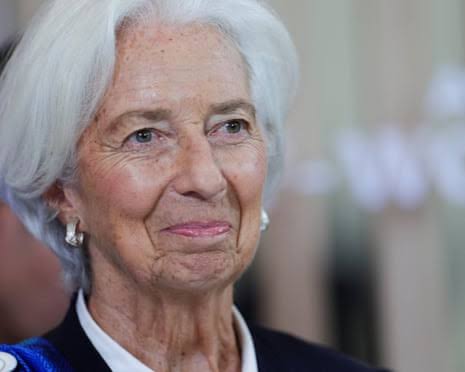
Christine Lagarde has announced that she will step down as President of the European Central Bank (ECB) on 7 February 2027, bringing forward her departure by approximately nine months and triggering the process to appoint her successor.Lagarde communicated her decision to colleagues at the institution’s Governing Council and subsequently shared the announcement publicly, expressing her pride in having served the European institution over the past seven years.
16 Killed, 46 Injured After Magnitude-7.0 Earthquake Strikes China’s Xizang
“It has been a source of great pride to serve this institution,” she said, thanking those who had supported her throughout her leadership.Her departure marks a significant moment for European economic governance, particularly as the eurozone continues to navigate inflationary pressures, geopolitical uncertainty, energy market disruptions and evolving global financial conditions.
Appointed in November 2019, Lagarde became the first woman to lead the ECB. Her presidency has coincided with several defining economic events, including the COVID-19 pandemic, Russia’s war against Ukraine, the subsequent energy crisis and the inflation surge that prompted the central bank to undertake a series of monetary policy adjustments.
Although her eight-year mandate was originally expected to conclude in October 2027, her decision to leave early will allow European institutions to begin the leadership transition ahead of schedule.
Speaking about her departure, Lagarde indicated that she wanted greater freedom of expression and the opportunity to engage in discussions beyond monetary policy matters, which are central to the responsibilities and institutional neutrality of the ECB presidency.
European Council President António Costa acknowledged her decision and praised her dedication since November 2019, highlighting her leadership during some of Europe’s most challenging economic and political circumstances.
The process of selecting her successor is being initiated through the European Union’s established appointment procedures. The European Council will appoint the next ECB president following a recommendation from the Council of the European Union and consultations with the European Parliament and the ECB Governing Council.
The transition comes at a particularly important time for the eurozone, where monetary policy decisions influence borrowing costs, inflation management, investment conditions and the economic outlook of 21 countries sharing the single currency.

Lagarde’s departure therefore represents more than a change in institutional leadership. It opens a new phase for one of the world’s most influential central banks, with the next president expected to navigate an increasingly complex international economic environment. As the appointment process begins, attention will turn towards the candidates and priorities that could shape the ECB’s next chapter and the future direction of Europe’s monetary policy.
Source: European Central Bank, European Council and international media reporting.