
A potentially record-breaking El Niño is developing in the tropical Pacific, raising concerns about extreme weather, intensified heat and a possible new global temperature record in 2027.
The phenomenon is expected to be the most intense El Niño in more than a century, according to the UK’s Met Office’s head of long-range forecasting. Scientists say its effects are likely to be amplified by human-caused climate change.
China’s Desertification Fight Offers Global Lessons as UN Conference Opens
What is El Niño?
El Niño is the warm phase of the El Niño-Southern Oscillation (ENSO), a natural climate cycle originating in the tropical Pacific Ocean. The event occurs when the trade winds that normally push warm water toward the western Pacific weaken. This allows warmer water to move eastward and rise toward the ocean surface. The resulting changes in sea-surface temperatures can disrupt atmospheric circulation, producing different weather patterns around the world.
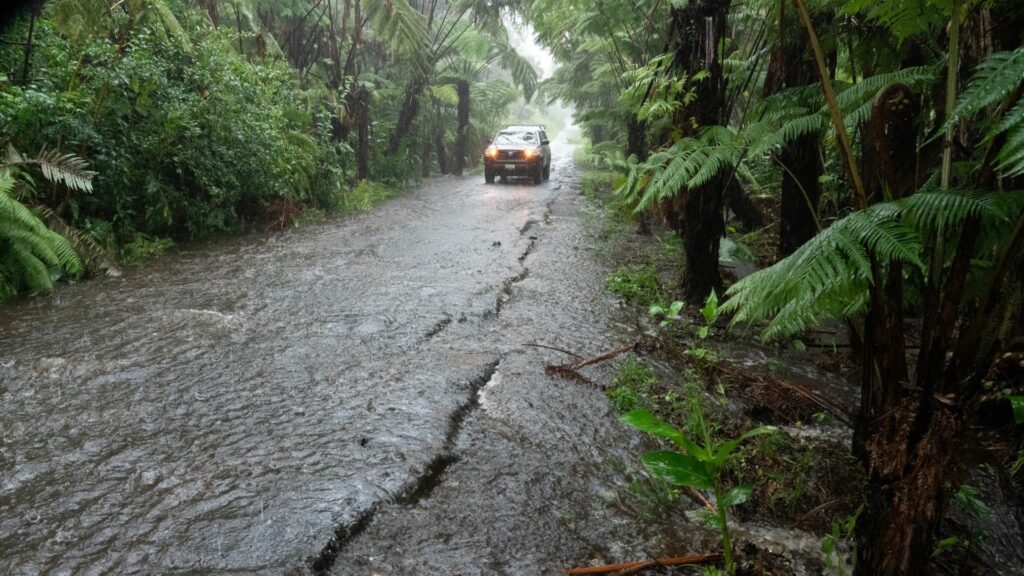
Some regions can experience unusually hot and dry conditions, while others may face heavier rainfall, flooding and cooler temperatures.
A potentially historic event
Sea-surface temperatures in the Nino 3.4 region of the Pacific are currently around 2.6 degrees Celsius above the rolling 30-year average, according to the Climate Brink dashboard, which draws on NOAA’s ocean observations.
Forecasts aggregated by the dashboard indicate that the temperature anomaly could reach approximately 3.9 degrees Celsius in November.
That would surpass the roughly 3-degree anomaly associated with the powerful 2015 El Niño. NOAA estimates a 69 percent probability that the current event could become the strongest El Niño in its dataset, which extends back to 1950.
Why 2027 could be exceptionally hot
Scientists say El Niño’s strongest influence on global temperatures often occurs after the event itself. Climate scientists Zeke Hausfather and Andrew Dessler estimate that El Niño could temporarily add approximately 0.3 degrees Celsius to the existing global warming trend.
Their calculations suggest global temperatures could reach around 1.76 degrees Celsius above pre-industrial levels in 2027 if current forecasts materialize.
That would potentially make 2027 the hottest year ever recorded, surpassing the current record held by 2024.
Texas A&M professor Andrew Dessler described the expected temperature increase as a preview of conditions the world could experience in the future, although much of the additional heat would be concentrated around the equatorial Pacific.
NOAA scientist Mike McPhaden similarly said that 2027 could potentially approach 1.7 degrees Celsius above pre-industrial levels if forecasts prove accurate.
Extreme weather impacts already emerging
The consequences of a strong El Niño are already being observed in some parts of the world. Indonesia, for example, is experiencing a prolonged dry season that has contributed to wildfires affecting hundreds of thousands of hectares.Scientists caution, however, that El Niño does not guarantee a specific weather outcome in every location.Michelle L’Heureux, ENSO team lead at NOAA’s Climate Prediction Center, said stronger events generally increase the likelihood or intensity of expected El Niño impacts.
El Niño and climate change
Climate change is adding another layer of risk. A warmer atmosphere can hold more moisture, meaning rainfall associated with El Niño can become more intense. At the same time, increased temperatures can dry soils and worsen drought conditions in regions already experiencing reduced rainfall.
Scientists remain less certain about whether climate change directly causes stronger El Niño events.However, emerging evidence suggests that a warmer climate could potentially amplify the natural cycle.
According to NOAA’s Mike McPhaden, warmer tropical oceans may make the atmospheric winds associated with El Niño more responsive to changes in ocean temperatures, strengthening the feedback mechanism that drives the phenomenon.
Researchers have also examined evidence from coral records, historical observations and climate models suggesting that the amplitude of El Niño events may have increased by around 10 percent over the past century.
Different ways of measuring El Niño
There is no single universally accepted measurement for determining the strength of an El Niño event.
In February, NOAA adopted the Relative Oceanic Niño Index (RONI), which compares warming in the Nino 3.4 region with warming across the wider tropical Pacific.
The index is designed to provide a clearer representation of the ocean-atmosphere conditions driving ENSO-related impacts.
Despite the differences between measurement systems, current forecasts point toward an unusually strong event.

What the world should watch
The coming months will be critical for determining whether the current forecasts materialize. A historically strong El Niño could affect food production, water availability, wildfire risks, infrastructure and disaster preparedness across multiple regions.
For countries already facing the effects of climate change, the combination of higher baseline temperatures and an intense El Niño could increase pressure on communities and ecosystems. Scientists therefore emphasize the importance of monitoring ocean temperatures, improving early-warning systems and preparing for potentially more severe weather extremes.