
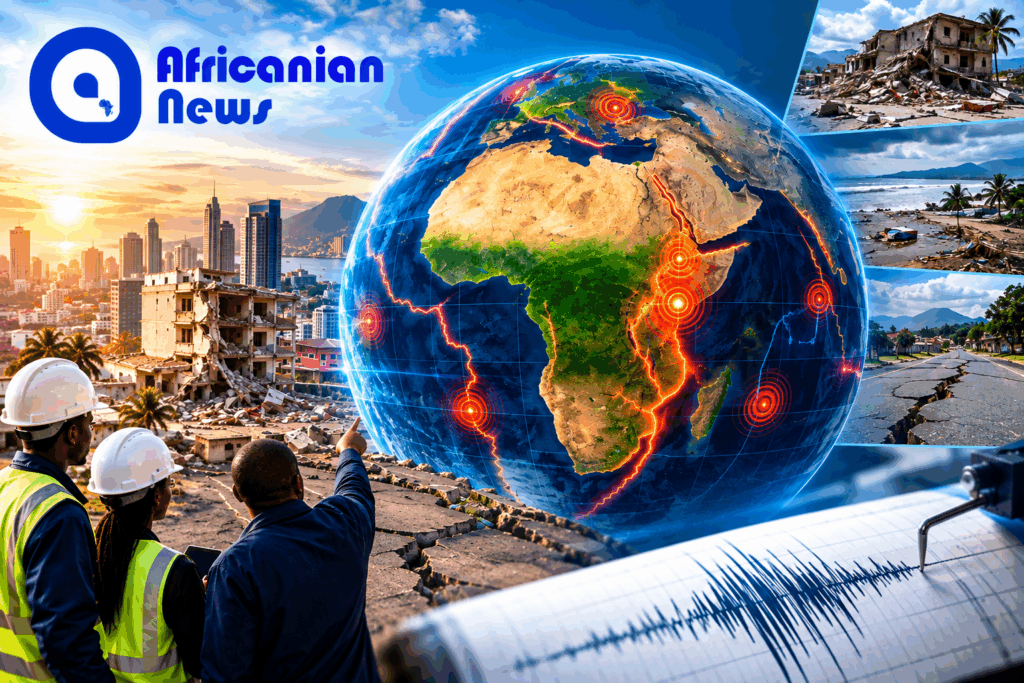
Recent earthquakes across several regions of the world have renewed attention on a natural hazard that can transform communities in seconds. From powerful tremors in Panama to seismic activity near Vanuatu, New Caledonia, Papua New Guinea, India and Indonesia, the latest events offer a broader reminder: earthquake preparedness cannot begin only after buildings crack, roads collapse or communities are forced to evacuate.
For Africa, the issue is particularly relevant as cities expand, populations grow and governments invest in roads, bridges, housing, energy facilities, ports and industrial infrastructure. The challenge is not to predict the exact date of the next major earthquake. Science cannot reliably determine precisely when and where a particular earthquake will occur. The challenge is to understand where seismic hazards exist and ensure that communities and infrastructure are prepared.
A World Experiencing Seismic Activity
Panama has been among the most closely watched earthquake locations in recent days. On 9 October 2026, a magnitude 7.7 earthquake struck southern Panama, followed by another powerful tremor and numerous aftershocks. Reuters reported on 11 October that more than 200 aftershocks had been recorded, at least 27 people had been injured and nearly 900 homes had been damaged, with assessments continuing in affected areas. The figures were preliminary and could change as authorities inspected more communities.
The event demonstrated how an earthquake can affect homes, public buildings, bridges and daily life even when widespread fatalities are avoided. It also illustrated why emergency communication, structural inspections and rapid assessments of critical infrastructure are essential after a major tremor.
Panama, however, is only one part of the wider picture.
On 8 October, the United States Geological Survey recorded a magnitude 6.3 earthquake near Norsup, Vanuatu. The USGS also recorded a magnitude 6.6 earthquake near Tadine, New Caledonia, on 25 September and a magnitude 6.4 earthquake near Kainantu, Papua New Guinea, on 20 September. These events occurred in regions where tectonic activity is an established feature of the geological environment.
Seismic activity has also been reported in South Asia. On 6 October, a magnitude 5.1 earthquake struck India’s Uttarakhand state, with tremors reportedly felt as far away as New Delhi. On 12 October, a magnitude 5.3 earthquake was reported in Indonesia’s Minahasa region. The scale, depth and consequences of earthquakes differ, and not every significant tremor produces major damage. Nevertheless, each event reinforces the importance of monitoring, risk awareness and construction practices suited to local hazards.
These earthquakes do not indicate that another major disaster is imminent in Africa. They are reminders that seismic hazards are global and that preparedness must be based on evidence, not speculation.
Africa’s Geological Reality
Africa is not uniformly exposed to earthquake risk. Many areas experience relatively limited seismic activity, while others are affected by active fault systems, tectonic boundaries and volcanic processes. Understanding those differences is fundamental to planning safer cities and infrastructure.
One of the continent’s most important geological features is the East African Rift System, which extends from the Afar region in the north through parts of Ethiopia, Kenya and Tanzania and into southern Africa. The system reflects the gradual separation of tectonic plates and is associated with earthquakes, volcanic activity and the formation of deep rift valleys.
North Africa also faces seismic hazards. The interaction between the African and Eurasian plates contributes to earthquake activity around the Mediterranean, affecting countries including Morocco and Algeria. Historical earthquakes in the region have shown how vulnerable buildings and densely populated communities can suffer severe consequences.
The relevant question is therefore not whether every African country faces the same danger. It is whether each country has adequately assessed its own exposure and translated that knowledge into building standards, land-use planning and emergency systems.
Seismic risk depends on more than the likelihood of an earthquake. It also depends on the number of people exposed, the quality of buildings, the location of critical infrastructure, the readiness of emergency services and the capacity of institutions to respond.
When Natural Hazards Become Human Disasters
Earthquakes are natural events, but the scale of their human consequences is strongly influenced by decisions made before they occur.
Buildings constructed without appropriate engineering, weak enforcement of construction standards, poorly planned urban expansion and limited public awareness can increase the danger. Hospitals, schools, bridges and electricity networks may become additional sources of vulnerability if their designs do not account for the hazards in their locations.
For African cities undergoing rapid expansion, this creates both a responsibility and an opportunity. New housing, industrial zones and public infrastructure can be designed to meet appropriate safety standards from the beginning. Retrofitting vulnerable older buildings can also reduce risk, particularly where schools, hospitals and densely occupied structures are concerned.
Earthquake-resistant construction does not necessarily mean making every building prohibitively expensive. It means applying appropriate engineering, using suitable materials, supervising construction and enforcing standards that reflect local conditions. The precise measures required vary according to the hazard, soil conditions, building type and intended use.
Africa’s Infrastructure Boom: An Opportunity to Build Safely
Across Africa, investment is reshaping transport networks, energy systems, housing and urban centres. These projects can support economic growth, trade and industrial development, but they also create long-term obligations.
A road, bridge or hospital built today may serve communities for decades. If seismic risk is ignored during planning, future repairs, reconstruction and disruption can impose substantial costs. By contrast, integrating risk assessments and suitable engineering into project design can help protect lives and preserve public investment.
Governments, construction companies, developers and financial institutions all have a role to play. Public procurement can require compliance with relevant building codes. Engineers and architects can incorporate locally appropriate hazard assessments. Regulators can strengthen inspection systems, while insurers and lenders can encourage risk-sensitive development.
African countries also have opportunities to exchange technical expertise and coordinate disaster preparedness across borders. Earthquakes do not respect administrative boundaries, and disruptions to transport, communications and supply chains can affect neighbouring economies.
Technology Can Improve Preparedness, but It Cannot Predict Everything
Advances in monitoring and data analysis offer useful tools for reducing seismic risk. Seismometers can detect and measure ground movement. Satellite observations can help researchers study changes in the Earth’s surface, while geographic information systems can map exposed populations, buildings and essential services.
Artificial intelligence and digital modelling can help authorities combine information about fault systems, soil conditions, building inventories and population density. These tools may improve hazard assessments, identify vulnerable infrastructure and support emergency planning.
However, technological progress should not be confused with the ability to predict a specific earthquake with certainty. AI cannot currently provide a dependable exact date, location and magnitude for an individual future earthquake. Forecasting aftershock probabilities and estimating long-term seismic hazards are different scientific tasks from predicting precisely when a major event will happen.
Technology is most useful when its findings inform practical decisions: where to strengthen buildings, where to locate emergency facilities, how to plan evacuation routes and how to communicate reliable warnings when an effective warning system is available.
Preparedness Must Reach Communities
National strategies and technical systems are essential, but preparedness must also reach ordinary people.
Communities need clear guidance on what to do during shaking, how to identify safer places, how to respond to damaged buildings and how to receive verified information. Schools, workplaces, hospitals and public institutions can conduct drills and establish emergency procedures appropriate to their circumstances.
Local authorities need reliable communication channels and plans for assisting children, older people, persons with disabilities and communities that may be difficult to reach. Emergency teams also require training, equipment and coordination to assess damage and deliver assistance.
Public awareness must avoid unnecessary alarm. The purpose of communicating seismic risk is not to convince people that a disaster is about to happen. It is to help them understand the risks in their area and know how to respond if an emergency occurs.
Resilience Is an Economic Strategy
Disaster preparedness is sometimes treated as an expense that can be postponed until resources become available. That approach can leave countries facing much larger costs after a disaster.
Earthquake damage can interrupt businesses, destroy homes, disrupt transport, displace families and place additional pressure on public finances. The effects may extend well beyond the affected location when roads, ports, electricity systems or supply chains are disrupted.
Resilience should therefore be considered part of economic planning. Investment in safer construction, hazard mapping, monitoring, emergency services and resilient public infrastructure can protect development gains and reduce avoidable losses.
For African economies seeking to expand manufacturing, trade, tourism, energy production and regional integration, the reliability of infrastructure is a development issue as much as a disaster-management issue.
Leadership Before the Ground Moves
The recent earthquakes across Panama, the Pacific and South Asia demonstrate the importance of preparing for hazards that cannot be scheduled or predicted precisely. Their lessons are not identical, and the level of risk differs from one region to another. What connects them is the need for credible scientific monitoring, appropriate construction, effective public communication and institutions capable of responding quickly.
For Africa, readiness begins with understanding local geological conditions and turning that knowledge into enforceable standards and practical plans. It requires cooperation among governments, scientists, engineers, businesses, emergency services and communities.
The continent does not need to anticipate an imminent catastrophe to justify taking these measures. It needs to recognise that resilient infrastructure is a foundation of sustainable development.
The next major earthquake anywhere in the world cannot be assigned a reliable date in advance. But the quality of preparation can be improved today.
Africanian Insight
The recent earthquakes in Panama and the wider Pacific region remind the world of the destructive potential of seismic events. They also demonstrate why monitoring, public communication, resilient infrastructure and effective emergency response matter.
They do not establish that Africa is on the verge of a comparable earthquake. The continent’s seismic risks must be evaluated according to its own geological conditions, regional hazards and levels of exposure.
As Africa accelerates urbanisation, expands industrial capacity and invests in infrastructure, resilience must become a foundational principle rather than an afterthought. Governments must consider not only how quickly they can build, but whether what they build will protect lives and continue functioning under pressure.
The next major earthquake cannot be scheduled, and science cannot reliably predict exactly where or when it will strike. But the risks facing individual communities can be assessed, and many of the consequences can be reduced through safer construction, better planning, scientific investment and public preparedness.

Africa’s future will not be determined solely by how fast it grows, but by how wisely it builds.Because the measure of progress is not simply what a nation constructs in times of calm. It is how well its people, institutions and essential services are protected when the unexpected happens.