
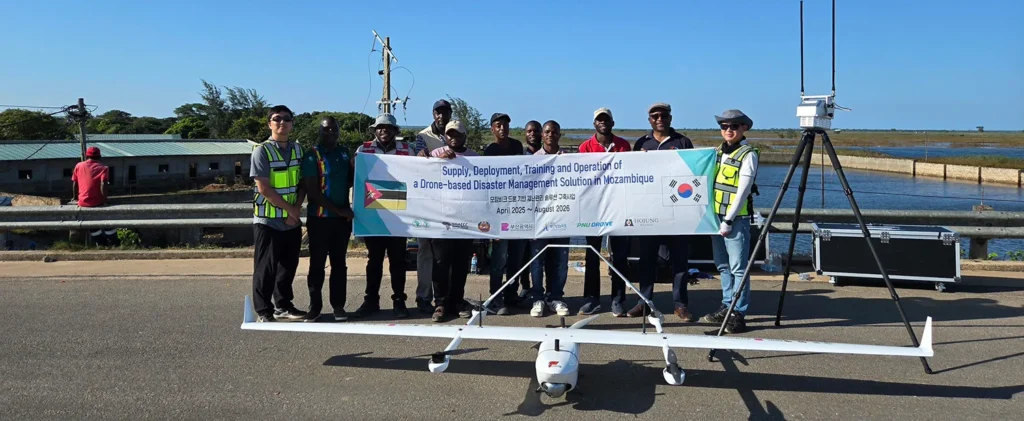
When Preciosa Mondlane looked up from the wreckage of her flooded home in January, she saw a drone circling overhead.“I had no idea what they were there for,” she recalled. “Were they here to help us, or for something else entirely?” They were there to help.
The drone above Ricatla was part of a disaster-management initiative supported by the African Development Bank, Korea and the Government of Mozambique. The technology had been introduced to strengthen Mozambique’s ability to monitor disasters, map affected areas and coordinate emergency responses. But when severe flooding struck before the programme was fully operational, the equipment and its newly trained operators were put to work.
For Marracuene, the results were extraordinary: despite widespread flooding and the destruction of homes and farmland, the district recorded no fatalities.
Cameroon Wins Women’s Africa Cup of Nations for First Time
The rains began in January and continued for weeks across Maputo and Gaza provinces. In Marracuene, north of the Mozambican capital, the Incomáti River overflowed across areas that residents had long known as its floodplain.
The familiar boundary between land and water disappeared.
Mondlane held out as long as she could before abandoning her flooded home. “I stayed put, clinging to the hope that the water wouldn’t dare reach us,” she said. Eventually, the rising water forced her to seek shelter with a neighbour.
“Even with all the generosity in the world, nothing replaces your own home,” she said.
Mayor Ahmad Shafee Sidat surveyed the flooded district as the landscape was transformed.
“All this area you can see down there — all that green — was completely underwater, with water levels rising higher than half the height of the houses,” he said. “Farmland, everything, turned into a river.”
The response capacity that emerged during the crisis had been built months earlier.
Since April 2025, Mozambique had been implementing the Drone-Based Disaster Management Project, financed through the Korea–Africa Economic Cooperation Trust Fund. The initiative was designed not simply to provide drones, but to build a national pool of specialists capable of operating the technology and converting aerial data into information that emergency teams could use.
The project delivered nine drone systems equipped with LiDAR sensors, simulators, unmanned surface vessels and data platforms.
More importantly, it trained 30 specialists from government institutions responsible for weather monitoring, water management, mapping, roads and disaster risk management.
For many of the participants, flying a drone was entirely new.
“Before this project, I had absolutely no experience with drones,” said Kátia Manjate, one of the newly trained pilots. Under Korean instructors, she learned to manage the entire process, from collecting aerial data to processing it and interpreting the results.
The training was supposed to culminate in emergency operations beginning in March 2026.
The floods arrived first.
At the request of the Mozambican government, the partially trained pilots were deployed months ahead of schedule. What had been intended as training equipment suddenly became an emergency response system.
Drones were used to locate stranded residents, map damaged and inaccessible roads and provide live imagery to rescue teams operating in areas that could not easily be reached from the ground.
The project was effectively subjected to its final examination in the middle of the disaster it had been designed to address.
For Rômulo Corrêa, the African Development Bank’s Country Manager for Mozambique, the experience demonstrated why the technology mattered.
“Drones are not just equipment,” he said. “They are tools that help emergency teams arrive faster. They are eyes on the ground when access is difficult.”
In Marracuene, that aerial visibility proved critical.
“We faced something that had never happened before in Marracuene,” Mayor Sidat said. “We managed to record not a single loss of life from the floods.”
He described the outcome as a victory and credited the African Development Bank and its partners with helping strengthen the district’s response.
The achievement, however, was not simply about drones.
The deeper objective of the partnership was to ensure that Mozambique could retain the knowledge and capacity after the project ended.
By July, all 30 pilots had graduated with national certification, while 10 were qualified to train additional operators. Specialists from the National Institute of Meteorology, the disaster-risk management agency, the Centre for Cartography and Remote Sensing, the roads administration and the water directorate were incorporated into the country’s technical disaster-response structures.
For pilot Hermelinda Nhamuche, the programme also opened a new professional path.
“I began to fall in love with this world of piloting drones, because it’s incredibly important for us, as a society that’s growing technologically,” she said.
The capabilities developed through the programme are expected to extend beyond flooding. Mapping, aerial surveillance and rapid data collection can support search-and-rescue operations, infrastructure assessment, disaster planning and emergency coordination.
Councilwoman Márcia Moiane said the significance of the programme goes beyond the technology itself.
“This project marks a major leap forward — not only in technology but also in how we respond to emergencies,” she said. “It means we can act faster and smarter, saving more lives.”

For Mondlane and other residents of Ricatla, the drones were first seen as mysterious machines hovering above a disaster.
They became something more important: an extra set of eyes when the ground could no longer provide a clear view.
The Incomáti River may continue to cross the boundaries that communities have drawn around it. But Mozambique now has trained specialists, technology and a national response system designed to see the next emergency sooner — and act before the water takes another life.