
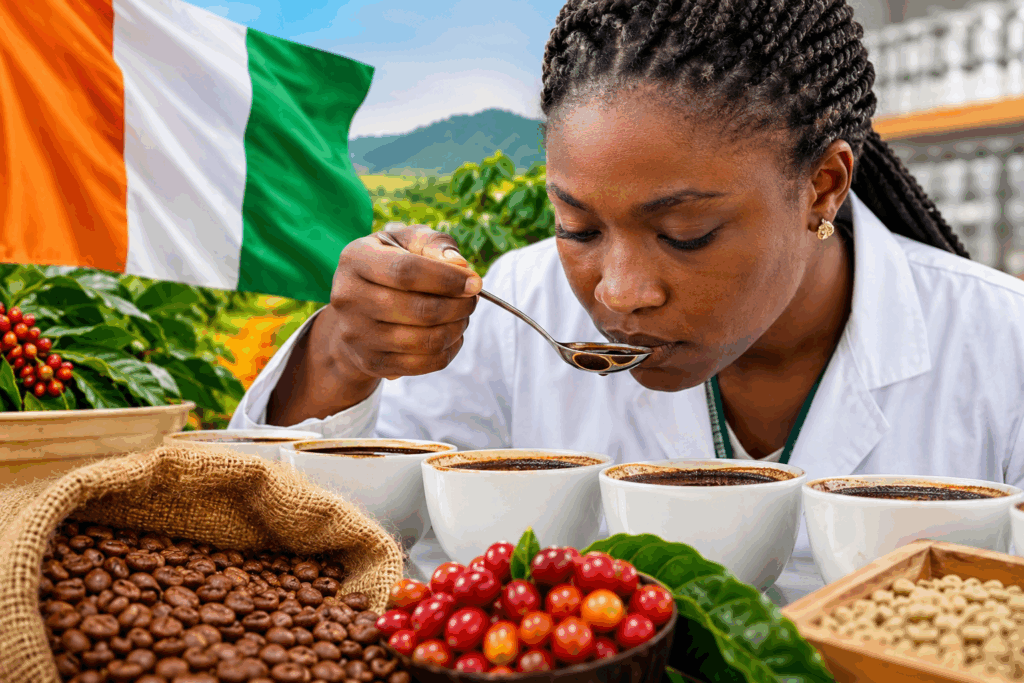
Côte d’Ivoire is investing in specialized coffee expertise as it seeks to strengthen the quality, competitiveness and international value of its Robusta production.
The country is the world’s sixth-largest Robusta coffee producer and produces more Robusta than almost any other country. While its production scale gives it an important position in the global market, the sector is increasingly focusing on developing local expertise capable of evaluating coffee quality and securing better prices.
Over six intensive days in July, 20 specialists from research, quality control and across the coffee value chain participated in an internationally recognized Coffee Quality Institute Q Grader training programme at the National Agronomic Research Centre (CNRA) cupping laboratory in Bingerville.
Angélique Kidjo Makes History as First Black African to Receive Hollywood Walk of Fame Star
The training was led by Rwandese coffee expert Grace Mukayisenga and covered the science of taste, green coffee defect identification, standardized cupping procedures, triangulation tests, olfactory blind testing and green coffee grading. The programme aims to give Ivorian professionals the skills required to assess coffee according to international standards and communicate its quality to buyers in global markets.
Denis Seudieu, Chief Economist of the International Coffee Organization, emphasized the importance of sensory expertise, noting that sellers who cannot properly taste and evaluate their coffee may struggle to accurately determine its value.
For Côte d’Ivoire, developing this expertise could help the country move beyond competing primarily on production volumes and instead position its coffee according to quality, opening opportunities to access specialty markets and premium prices.
Adiko Evelyne, a conservation and agricultural products researcher at CNRA, said the training provided practical experience in identifying green coffee defects that participants had previously encountered mainly through theory. She highlighted the ability to identify defects including floaters, quakers and sour beans.
The initiative was supported by the International Trade Centre through the ACP Business-Friendly programme, jointly funded by the European Union and the Organisation of African, Caribbean and Pacific States.
The programme was implemented in partnership with CNRA, the Conseil Café-Cacao, the Robusta Coffee Agency of Africa and Madagascar (ACRAM), and the Association of Coffee Promoters (ASPROCAF).
The investment has also extended beyond training. The CNRA cupping laboratory in Bingerville was upgraded with precision equipment, including sample roasters and sensory kits, helping bring its facilities closer to international accreditation standards.
The International Trade Centre said the initiative forms part of a broader effort to shift Côte d’Ivoire’s coffee sector from raw commodity exports toward quality-driven value addition supported by local expertise.
The 20 newly trained Q Graders are expected to contribute to the development of national capacity by applying their skills, supporting quality standards and helping train future specialists.

As Côte d’Ivoire seeks to capture more value from one of its important agricultural commodities, strengthening the ability to assess, communicate and market coffee quality could become an important tool for competing in increasingly demanding international markets.