
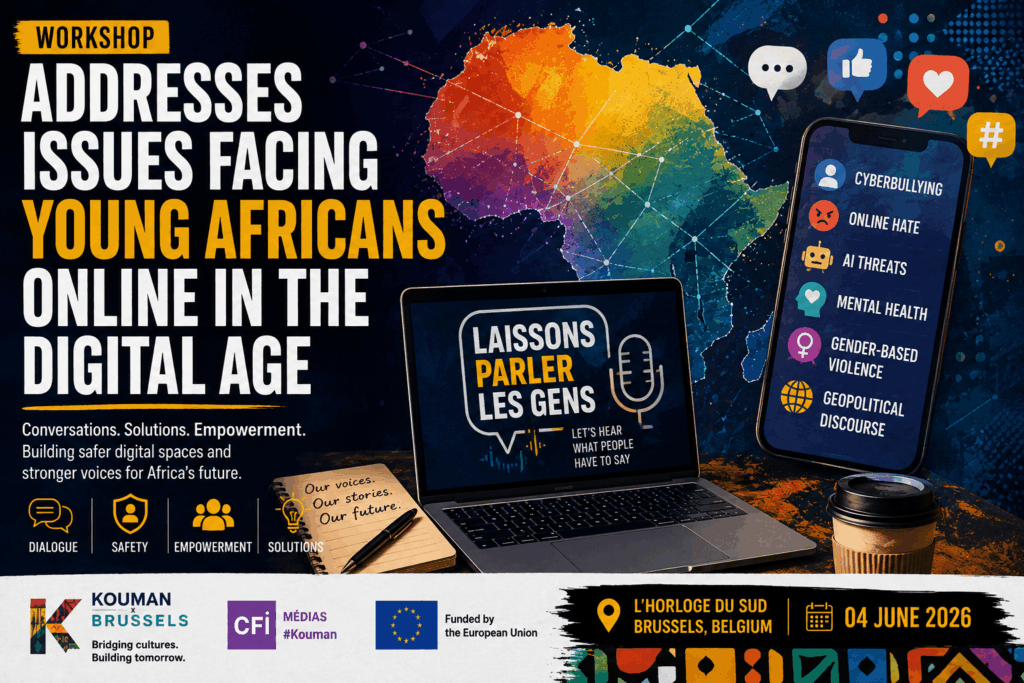
Young Africans navigating an increasingly digital world took center stage in Brussels as artists, content creators, media professionals, researchers, and youth advocates gathered to discuss the opportunities and challenges shaping a new generation online.
The event formed part of the Kouman x Brussels initiative, a cultural and social project designed to strengthen connections between Africa and Europe through dialogue, creativity, and digital storytelling. Held in the Belgian capital, the gathering focused on how young Africans are experiencing social media, online communities, and emerging digital technologies while addressing pressing concerns ranging from cyberbullying to Artists, digital creators and youth advocates gathered in Belgium to explore cyberbullying, online hate, artificial intelligence and the future of digital engagement for young Africans.artificial intelligence.
China-Africa Summit Calls for Deeper Trade and Development Ties
At the heart of the discussions was the popular Ivorian podcast “Laissons Parler les Gens” (“Let’s Hear What People Have to Say”), a platform that uses humour, culture, and storytelling to spark conversations about issues affecting African youth. Through open dialogue and audience participation, the initiative seeks to create safe spaces where young people can share experiences, challenge stereotypes, and explore solutions to common social challenges.
One of the event’s most prominent participants was Congolese rapper and songwriter Youssoupha, whose career has made him one of the most influential voices in Francophone African music. Speaking to attendees, he acknowledged the growing pressures young people face online but encouraged them to focus on opportunities rather than obstacles.
“We tend to be placed in tough situations. But the hard times, they’re always going to be there, no matter the era or generation,” Youssoupha said.
The award-winning artist urged young people not to become consumed by negativity, emphasizing the importance of surrounding themselves with supportive communities, positive influences, and opportunities for personal growth. “We’re going to move forward with the people who encourage us, the resources, the talents, and the strengths. That’s what will take us upward,” he said. “Everything that doesn’t help us move forward is useless.”
The event, supported by the CFI Médias #Kouman project and the European Union, also featured Belgian-Congolese digital creator Vanessa Caixeiro and Ivorian-French comedian Sacko Camara, both of whom shared personal insights into navigating life in the digital spotlight.
The day began with workshops involving researchers, development experts, educators, and institutional stakeholders examining how digital platforms can better engage younger audiences. Discussions focused on strengthening civic participation, encouraging responsible digital citizenship, and using online tools to drive positive social change.
Participants later joined a listening club where they discussed podcast episodes covering a wide range of topics including cyberbullying, online hate speech, malicious AI-generated content, mental health, gender-based violence, misinformation, and geopolitical debates increasingly influencing conversations among young Africans.
For many attendees, the workshops highlighted the growing importance of creating digital spaces that promote understanding rather than division. Brussels-based actress Blessing Ngoy emphasized that discussing challenges is only the first step and that meaningful progress requires practical solutions. “I think today our generations are trying to implement solutions and measures that ensure that, as much as we want to heal a society that has suffered in the past, at the same time we tell ourselves that it is possible to live together,” she said.
Ngoy argued that young people should be given greater trust and responsibility in shaping the future, noting that many are actively seeking ways to build more inclusive and connected communities. Her views were echoed during a live audience recording of “Laissons Parler les Gens,” where Vanessa Caixeiro spoke candidly about the realities of social media fame and the emotional challenges that often accompany online visibility.
Known for her podcast series “Les Confessions de Vanessa,” where she openly discusses personal struggles, faith, mental health, and healing, Caixeiro described social media as both an opportunity and a risk. “You have to bear in mind that social media is like a double-edged sword: it can either make you or break you,” she said. “There’s no success without a struggle, and success that comes easily today will lead to a big fall tomorrow.”
She encouraged young Africans to develop resilience and self-confidence, emphasizing that personal worth should never depend solely on online validation.
Meanwhile, comedian Sacko Camara approached the issue from a different perspective, combining humour with psychological insight to explain how individuals can protect themselves from online abuse.
“When people attack you online, they’re not attacking who you really are; they’re attacking the image they’ve built up of you,” Camara explained. “If you understand that, their words can no longer hurt you.”
His comments resonated with audience members who shared experiences of digital harassment and highlighted the growing need for conversations around mental well-being in online spaces.
According to UNICEF, approximately 34 percent of respondents in Sub-Saharan Africa reported experiencing online bullying in a 2019 survey, with social media platforms such as Facebook, Instagram, Snapchat, and X among the most frequently cited channels where abuse occurs. The figures underscore the urgency of addressing digital safety as internet access continues to expand across the continent.
For organizers at Istorias Media, creators of “Laissons Parler les Gens,” initiatives like the Brussels workshop demonstrate the power of media and storytelling to foster dialogue, strengthen social cohesion, and empower young voices. “Laissons Parler les Gens is aimed at young people, bringing them together and creating a space where they can express themselves,” said Marta Rodriguez Martinez, co-founder of Istorias Media. “Today, we leave this event with a great deal of hope and many opportunities for social cohesion.”
International development expert Mame Peya Diaw also emphasized the importance of awareness and education in addressing online challenges facing African youth.“We think this kind of project is really important for African youth because it helps raise awareness, it helps us communicate, and it provides many prospects for African youth,” she said.
As digital technologies continue to transform societies across Africa, initiatives such as Kouman x Brussels highlight the growing role of culture, media, and youth-led dialogue in helping young people navigate the complexities of life online while building more resilient and inclusive digital communities.