
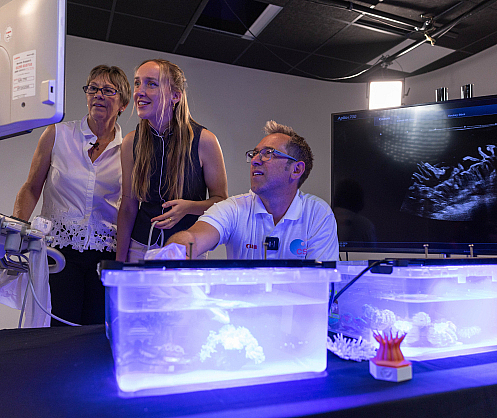
A scientific breakthrough is offering researchers an unprecedented opportunity to understand coral reproduction without damaging living specimens. Coral Spawning International (CSI), in partnership with Canon Medical Systems UK and Canon EMEA, has successfully conducted what the organizations describe as the world’s first ultrasound scans of living coral to identify developing eggs.
The experiment, carried out using Canon’s advanced Aplio i700 ultrasound platform, demonstrates how medical imaging technology can be adapted beyond human healthcare to address important challenges in marine science and environmental conservation.
During the research, scientists examined six species of large polyp stony (LPS) coral with different skeletal structures, keeping the specimens completely submerged in water throughout the scanning process. Using high-frequency and ultra-high-frequency ultrasound probes, researchers were able to observe intricate internal structures and identify developing egg formations without cutting into or sacrificing the corals.
Traditionally, investigating coral reproductive development has required researchers to remove or fragment specimens to examine their internal structures. These procedures can damage valuable coral colonies and limit the ability to monitor their natural reproductive cycles. The new ultrasound approach offers a non-invasive alternative, potentially transforming how scientists study coral reproduction.
To validate the findings, researchers examined a specimen of Trachyphyllia geoffroyi by comparing ultrasound images with macro photography of a fragmented sample. This cross-referencing confirmed that the structures identified through ultrasound were developing eggs, establishing the technology as a viable method for assessing reproductive development in corals.
Dr Jamie Craggs, Co-Founder of Coral Spawning International, described the discovery as an extraordinary scientific moment, highlighting the opportunity to observe reproductive processes inside living coral with remarkable detail. He explained that continued monitoring throughout spawning periods could provide a much deeper understanding of how different coral species reproduce.
For Canon, the experiment also demonstrates the broader potential of medical imaging technologies beyond conventional clinical applications. Sally Davey, Clinical Product Specialist at Canon Medical Systems UK, noted that the successful trial could open opportunities for further applications in areas such as minimally invasive surgery and the diagnosis of dermatological conditions.
Peter Bragg, Sustainability and Government Affairs Director at Canon EMEA, emphasized the importance of imaging innovation in revealing previously inaccessible information and improving scientific understanding of the natural world.
The research will continue over the next six months, with scientists monitoring the coral specimens and recording their reproductive activity when gametes are released. These observations will help CSI develop a more detailed understanding of LPS coral reproductive cycles and improve the accuracy of predictions concerning spawning periods.
Identifying spawning windows more precisely is particularly important for coral conservation. Reproduction is a critical stage in the natural regeneration of coral reefs, and knowing when corals are preparing to release eggs and sperm allows researchers and restoration practitioners to coordinate breeding, propagation and restoration activities more effectively.
The breakthrough comes at a time when coral reef ecosystems face growing environmental pressures, including rising ocean temperatures, marine pollution and habitat degradation. As reefs support marine biodiversity, coastal protection, fisheries and livelihoods across numerous regions, improving scientific understanding of coral reproduction is increasingly important to global conservation efforts.
Coral Spawning International specializes in land-based sexual coral reproduction, selective breeding and restoration research. Its work focuses on equipping reef managers, restoration practitioners and researchers with the knowledge and tools needed to reproduce coral in controlled facilities and contribute to the recovery of damaged reef ecosystems.

By combining medical imaging expertise with marine reproductive science, the collaboration between CSI and Canon illustrates how technologies developed for healthcare can generate unexpected solutions to environmental challenges. Beyond its immediate scientific significance, the development offers a promising new tool for protecting coral biodiversity and advancing restoration efforts across the world’s oceans.