
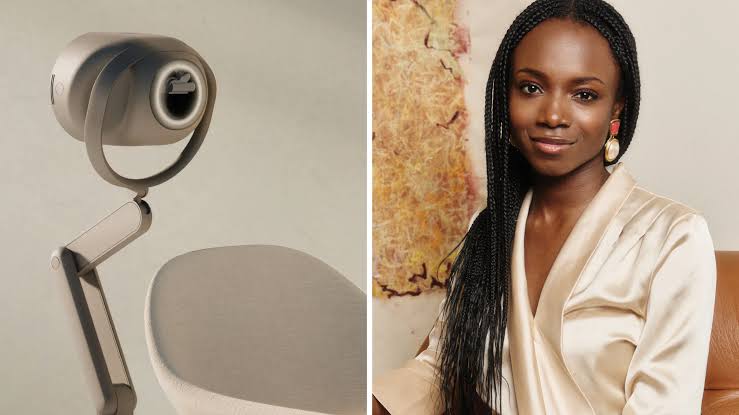
A Nigerian-American biomechanical engineer, Yinka Ogunbiyi, is attracting international attention after developing HaloBraid, an innovative robotic device designed to assist professional hairstylists in braiding hair faster and with less physical effort.
The invention brings robotics into an industry deeply connected to African culture, identity and entrepreneurship, offering a new approach to one of the world’s most familiar beauty practices.
For millions of women across Africa and the African diaspora, hair braiding is more than a beauty routine. It is a cultural expression, a creative tradition and an important source of income for thousands of independent hairstylists and salon businesses. Yet, despite advances in beauty technology, the actual process of braiding has remained largely dependent on manual work.
Ogunbiyi’s inspiration came from personal experience. During the COVID-19 lockdown in 2020, she attempted to braid her own hair and spent four days completing the process. The experience prompted her to consider how engineering and automation could make the procedure less time-consuming and physically demanding.
Working alongside co-founder David Afolabi, she began developing a robotic system capable of assisting with the repetitive movements involved in creating braids. The team reportedly developed more than 600 prototypes before arriving at the technology behind HaloBraid.
Unlike conventional expectations surrounding automation, HaloBraid is not designed to replace professional hairstylists. Instead, it operates as a collaborative robotic assistant. The stylist manually sections the hair, prepares the braid and establishes its foundation before transferring the repetitive weaving process to the device. The professional then takes over again to complete the final styling.
According to the company, the technology can complete individual braids up to five times faster than conventional manual weaving. This could significantly reduce the duration of certain appointments while allowing stylists to accommodate more customers and spend less time performing repetitive hand movements.
The physical demands of professional braiding are another important consideration behind the invention. Hairstylists frequently spend long hours performing repetitive movements that can contribute to wrist, hand and shoulder strain. By automating part of this process, HaloBraid aims to reduce the physical burden while preserving the craftsmanship and creativity of the profession.
The innovation has also attracted considerable investor interest. In July 2026, HaloBraid secured US$7 million in seed funding, led by Seven Seven Six, the venture capital firm founded by Reddit co-founder Alexis Ohanian, with participation from AlleyCorp and Bling Capital. The funding is intended to support product development, manufacturing and expansion into professional salons.
The company has also reported significant interest from the beauty industry, with more than 7,000 salons reportedly joining its waiting list. The development has placed Ogunbiyi among the emerging entrepreneurs bringing engineering solutions to markets that have historically received limited technological investment.
Her achievement also represents an important contribution to conversations about African innovation and the global potential of African talent. Across the continent, traditional industries such as beauty, fashion, agriculture, manufacturing and creative services provide opportunities for technological transformation. Combining practical knowledge with engineering can open new markets, improve productivity and create opportunities for businesses and skilled professionals.
For Africa’s beauty industry, the possibilities are particularly significant. The continent has a thriving haircare economy supported by independent braiders, beauty entrepreneurs, product manufacturers, salons and informal businesses. Technologies that improve efficiency without eliminating the human expertise behind these services could create new opportunities across this ecosystem.
Nevertheless, the success of such technology will depend on accessibility, affordability, adaptability to different hair textures and the ability to preserve the quality and cultural significance of traditional hairstyles. Its long-term potential will also depend on how effectively it can be integrated into existing salon businesses.
Ogunbiyi’s broader ambition extends beyond a single machine. Through Halo, she aims to develop technologies that make textured haircare faster, more accessible and more comfortable. HaloBraid is the company’s first major product, with further innovations being explored.
Her journey demonstrates how personal experiences can become the starting point for technological breakthroughs. What began as a frustrating four-day attempt to braid her own hair has evolved into a funded engineering venture with international ambitions.
At a time when conversations about artificial intelligence and robotics frequently focus on replacing human labour, HaloBraid presents a different approach: using technology to support skilled workers, protect their physical well-being and create opportunities for business growth.
For Africa and its global diaspora, the story is also a reminder that innovation does not always begin in laboratories addressing the world’s most complex problems. Sometimes, it starts with recognizing an everyday challenge, questioning why it has remained unchanged and developing a solution that can benefit millions.
By bringing robotics into the world of hair braiding, Yinka Ogunbiyi is helping demonstrate how African-connected creativity, engineering and entrepreneurship can contribute to the future of global industries.