
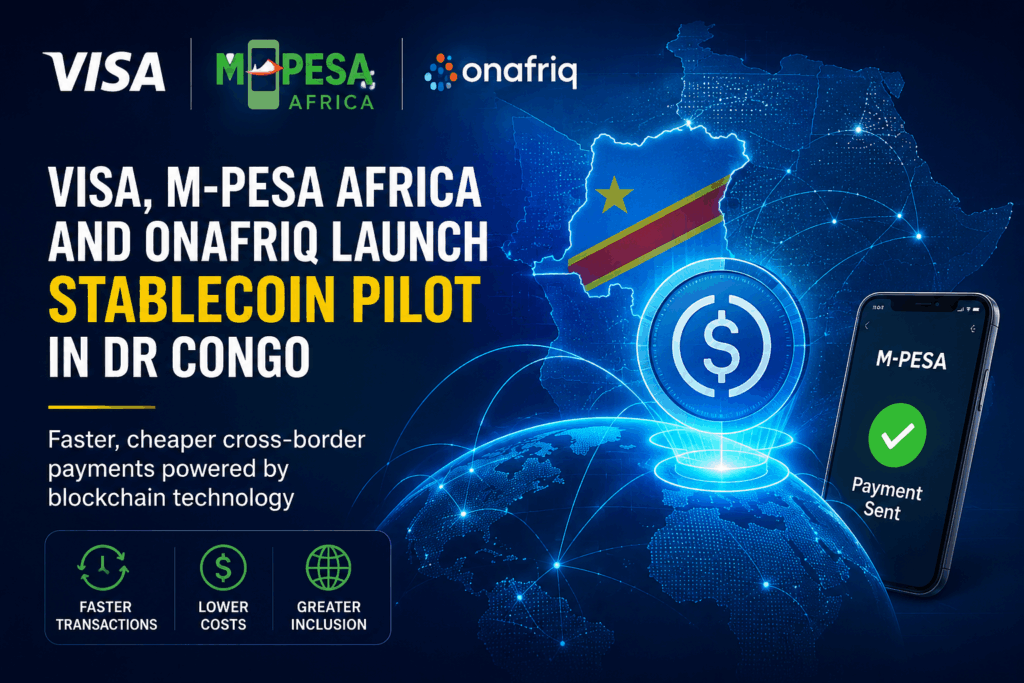
Global payments leader Visa has joined forces with M-PESA Africa and pan-African fintech company Onafriq to launch a groundbreaking stablecoin pilot in the Democratic Republic of the Congo (DRC), a move that could redefine the future of cross-border payments across Africa.
The initiative will test the use of blockchain-backed stablecoins to facilitate international mobile money transactions, offering an alternative to traditional cross-border payment systems that are often slower, more expensive, and less accessible for millions of Africans.
The pilot reflects the growing convergence between mobile money, blockchain technology, and global payment networks as financial institutions seek innovative solutions to modernize international remittances and improve financial inclusion across emerging markets.
Equatorial Guinea Steps Up Preparations to Host ICAO’s ICAN 2026 Conference
Stablecoins are digital assets designed to maintain a stable value by being pegged to traditional currencies, making them less volatile than many cryptocurrencies. By integrating stablecoin technology into mobile money ecosystems, the partners aim to enable near-instant international settlements while significantly reducing transaction costs for consumers and businesses.
Cross-border payments remain one of Africa’s most persistent financial challenges. Millions of people rely on remittances to support families, pay school fees, finance businesses, and cover healthcare expenses. However, traditional banking channels often involve multiple intermediaries, lengthy settlement periods, and relatively high transfer fees.
Through this pilot, Visa, M-PESA Africa, and Onafriq hope to demonstrate how blockchain infrastructure can simplify these processes by allowing value to move across borders more efficiently while maintaining security, transparency, and regulatory compliance.
The Democratic Republic of the Congo has been selected as the first market to test the solution, placing the country at the forefront of digital payment innovation on the African continent. The pilot will evaluate how stablecoin-powered settlements can improve interoperability between mobile money platforms and international payment networks.
If successful, the project could establish a new model for cross-border financial services, allowing individuals, merchants, and small businesses to send and receive funds more quickly while reducing reliance on costly correspondent banking systems.
The initiative is particularly significant given Africa’s leadership in mobile money adoption. According to industry data, the continent hosts the majority of the world’s mobile money accounts, making digital wallets an essential financial tool for millions of people who remain underserved by conventional banking institutions.
By combining Visa’s global payment infrastructure with M-PESA Africa’s extensive mobile money ecosystem and Onafriq’s pan-African payments network, the partnership aims to create a more connected and efficient financial ecosystem capable of supporting growing regional trade and international commerce.
Beyond individual remittances, the pilot could also benefit small and medium-sized enterprises (SMEs), which frequently encounter difficulties when making cross-border payments due to high banking fees and settlement delays. Faster transactions and lower costs could improve cash flow, facilitate trade, and encourage greater participation in regional and international markets.
The collaboration also reflects increasing confidence among global financial institutions in blockchain technology as a practical tool for modernizing payment infrastructure. Rather than replacing existing financial systems, stablecoins are increasingly being explored as complementary technologies capable of improving efficiency, reducing operational costs, and expanding access to financial services.
Industry analysts believe initiatives such as this could accelerate the integration of Africa’s rapidly growing fintech sector with global financial markets while supporting the objectives of the African Continental Free Trade Area (AfCFTA), which seeks to simplify trade and financial flows across the continent.
The project further demonstrates the growing role of partnerships between international payment companies and African fintech innovators in driving financial innovation. As digital payment adoption continues to rise, collaboration between established financial institutions and technology companies is expected to play an increasingly important role in building more inclusive and resilient financial ecosystems.
For the Democratic Republic of the Congo, hosting the pilot represents an opportunity to showcase its potential as a testing ground for next-generation financial technologies while supporting broader efforts to expand digital financial services and increase economic participation.
Should the pilot prove successful, the partners may consider expanding stablecoin-powered cross-border payment services into additional African markets, potentially opening a new chapter in the evolution of mobile money and digital finance across the continent.

The initiative underscores a broader transformation taking place within Africa’s financial services industry, where blockchain, mobile technology, and digital payments are increasingly converging to create faster, more affordable, and more inclusive financial solutions for individuals, businesses, and economies.