
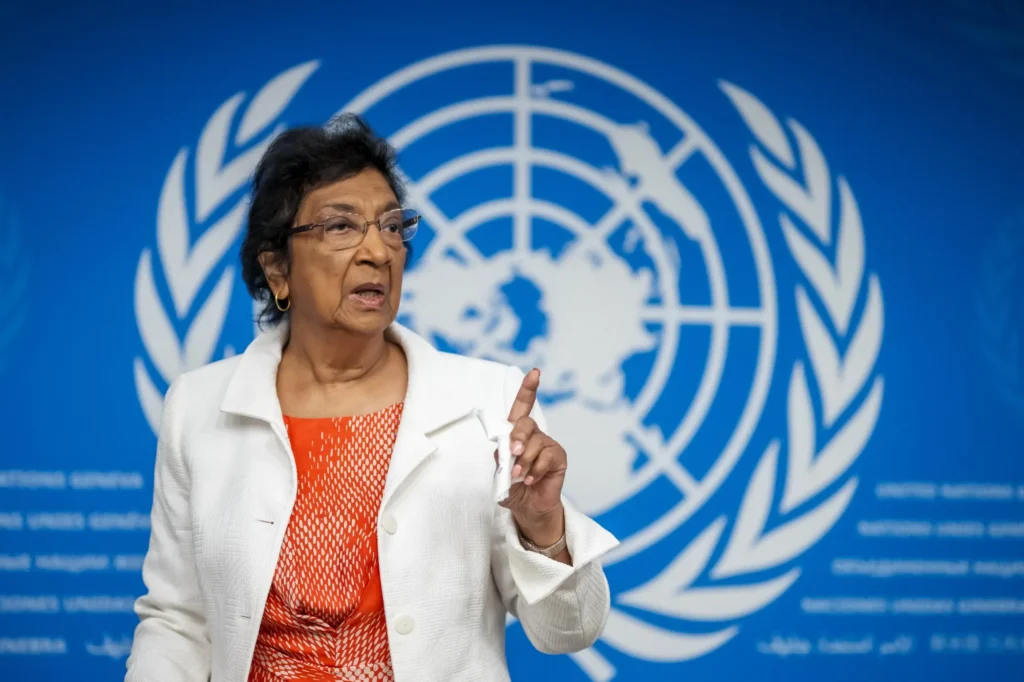
South African jurist Navanethem “Navi” Pillay has been awarded the 2026 Nobel Peace Prize, placing an African legal pioneer at the centre of global efforts to defend human rights, strengthen international justice and hold perpetrators of serious crimes accountable.
Announced by the Norwegian Nobel Committee on 9 October, the award recognises Pillay’s contribution to promoting peace and international law. Her career reflects decades of work advancing human dignity, legal accountability and the protection of fundamental freedoms.
Gabon Opens First Tier III Data Centre to Advance Digital Future
Born in Durban in 1941 into a family of Indian Tamil origin, Pillay grew up under South Africa’s apartheid system, where racial discrimination restricted opportunities and denied fundamental rights to millions. In 1967, she established her own law firm in Durban and represented activists opposing apartheid. Her professional journey developed against a backdrop of institutionalised racism, making the rule of law both a professional calling and a central principle of her public service.
Following South Africa’s democratic transition, Pillay joined the country’s High Court in 1995. Her subsequent international career took her into some of the most consequential legal proceedings addressing mass violence and human rights abuses.
One of her most significant contributions came through her work at the International Criminal Tribunal for Rwanda, where she served as a judge and later president from 1999 to 2003. She played an important role in the tribunal’s landmark case against Jean-Paul Akayesu. The proceedings helped establish that rape and other forms of sexual violence could constitute acts of genocide when committed with the requisite intent, as well as crimes against humanity. The ruling marked a major development in international criminal law and strengthened recognition of sexual violence as a tool of mass atrocities.
Pillay later served as a judge at the International Criminal Court and as United Nations High Commissioner for Human Rights from 2008 to 2014. In these positions, she contributed to international efforts to advance accountability, protect fundamental freedoms and reinforce the principle that no individual should stand above the law.
Between 2021 and 2025, she chaired the UN Independent International Commission of Inquiry on the Occupied Palestinian Territory, including East Jerusalem, and Israel. The commission’s work brought renewed international attention to alleged violations of international law and the protection of civilians, illustrating the difficult environment in which legal experts and human rights institutions operate.
For Africa, Pillay’s Nobel Peace Prize carries significance beyond individual achievement. It highlights the contribution of African legal professionals to shaping international standards and strengthening mechanisms designed to protect people from abuses of power. Across the continent, justice, institutional accountability, democratic governance and access to legal protection remain central to debates about sustainable peace and development.
Her recognition also challenges narratives that portray Africa primarily through the lens of conflict and instability. African professionals have helped shape the legal principles through which the international community investigates atrocities, recognises victims and pursues accountability. For emerging generations of African lawyers, researchers, diplomats and human rights advocates, Pillay’s journey demonstrates how professional competence, persistence and ethical conviction can translate into international impact.
Her award comes amid wider questions about whether international institutions can consistently enforce the principles they defend. The effectiveness of international law depends not only on treaties and court judgments, but also on the willingness of governments to respect legal obligations and cooperate with independent accountability mechanisms.
Pillay’s career underscores the importance of those institutions, particularly when allegations involve powerful political actors or deeply polarised conflicts. Her recognition should not be interpreted as a judicial ruling on any individual conflict or allegation, but as an acknowledgement of her broader commitment to international legal principles and human rights.

As the international community confronts wars, displacement and persistent human rights violations, Pillay’s Nobel Peace Prize serves as both a recognition of a lifetime of service and a reminder of the work that remains unfinished. Her achievement carries a message for Africa and the wider world: lasting peace requires institutions that protect human dignity, uphold the rule of law and ensure that serious crimes can be investigated without impunity.