“Since my husband passed away in 2004, I decided to start farming so that I can support my three children,” says Queen Shonga.
Nyashonga, as she is fondly called by people of Mtuwa Village in the area of Traditional Authority (TA) Kabunduli in Nkhata Bay District, practices integrated farming.
She grows maize, coffee, pineapples and rears goats and chicken.
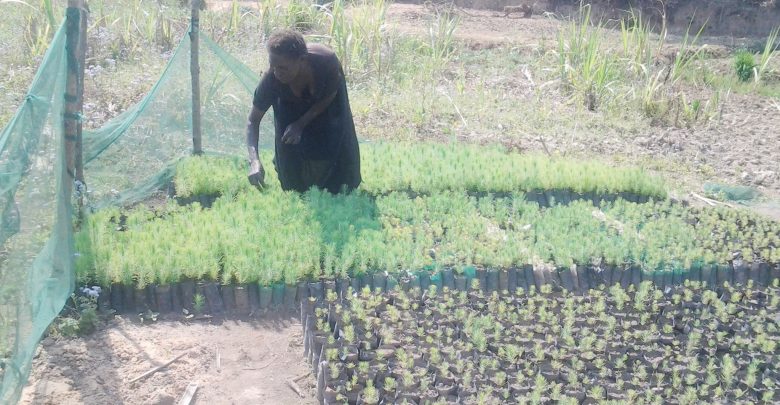
As if this is not enough, Nyashonga is contributing to Malawi’s quest for reforestation of degraded environment by raising pine tree seedlings.
Apart from planting on her own piece of land, she produces enough seedlings that she sells to other members of the community.
“So far, I have planted 300 pine trees and about 500 coffee plants. I will continue planting coffee and pine trees because I know they are my gold in the near future.
“When it will be time to start harvesting, I am assured that I will have sustainable source of income to support me in my old age,” Nyashonga explains.
Nyashonga is among 5,603 households that benefit from the government’s Social Cash Transfer Programme.
As one way of tackling Sustainable Development Goal I which is, “end poverty in all its forms everywhere,” government introduced the Social Cash Transfer Programme to tackle poverty in the country.
The programme targets resource poor households to empower them with cash which they can invest in sustainable microeconomic activities.
“Things started moving well after I was put under the Social Cash Transfer Programme in June 2016. I bought two goats and started serious farming.
“Later, when I started realising profits, I started building a burnt brick house,” explains Nyashonga. She says when the goats multiplied to eight, she sold two and bought fertilizer for her maize field.
“Currently, I have five goats because we also slaghted one for household consumption,” Nyashonga says.
She hails the Social Cash Transfer Programme saying it has empowered her financially.
“I have managed to educate my children using money realised from cultivation of pineapple, yams and maize.
“Now farming is in my business,” says Nyashonga proudly.
Although 61, Nyashonga does not solely rely on hired labour to do the actual work. She physically does most of the work herself.
Her story is in line with the safety net programme’s main objective of economic empowerment.
Nkhata Bay is among 11 districts in the country that are implementing the Social Cash Transfer Programme.
Financed by World Bank through the National Local Government Finance Committee (NLGFC), the programme started in February 2015 in all the 16 Traditional Authorities in the district.
The programme was introduced to fulfill Sustainable Development Goal II which is to end hunger, achieve food security and improved nutrition and promote sustainable agriculture.
A 2016 to 2017 Integrated Household Survey Report indicates that 50.7 percent of Malawi’s population lives below the poverty line and 25 percent are in extreme poverty.
The survey’s findings are not surprising as the country ranks so low on the World Human Development Index at 170 out of 188 countries and territories.
In its quest to salvage the situation, Malawi Government embarked on various social support programmes targeting a diverse range of beneficiaries.
As some initiatives target strong and energetic community members, others, such as the Social Cash Transfer Programme, are only meant for ultra-poor and labour-constraint households.
The programme is under Malawi Social Action Fund (Masaf)-IV and has been in existence for 12 years. It was initially piloted in selected districts until 2018 when it spread to the rest of the country.
Since Social Cash Transfer Programme started in Malawi in 2012, about €13 million (about K9.2 billion) has been pumped into the programme.
Nkhata Bay District Principal Social Welfare Officer responsible for Social Cash Transfer Programme Wisdom Mwafulirwa says the programme has transformed lives of most beneficiaries in the district.
“Household beneficiaries are investing in productive assets like piggery, goat and chicken farming. Most of these households have built houses using burnt bricks and iron sheets.
“The most important thing is that most households are now able to eat three meals a day,” he says.
Mwafulirwa explains that, as a sustainability mechanism, government encourages social cash transfer beneficiaries to join Community Savings and Investment Promotion (Comsip) groups.
Comsip is a capacity enhancement initiative designed to inculcate the culture of savings in both rural and urban communities.
“Members save money and do small-scale businesses to support their families and at the end of the year, they share the dividends,” Mwafulirwa says.
On challenges, Mwafulirwa acknowledges that often money meant for cash transfers is disbursed late, a thing that, he says, affects the beneficiaries’ budget.
“We are supposed to be disbursing funds every two months but sometimes we even take four months which affects the beneficiaries’ budget especially for food and school materials,” he says.
Amid the challenges, Minister of Gender, Children, Disability and Social Welfare, Mary Navicha, lauds the Social Cash Transfer Programme.
“We have seen the targeted families being able to buy food or produce enough on their own as well as send their children to school.
“The beneficiaries are able to do small-scale businesses and acquire fixed assets like decent houses and livestock,” Navicha says.