
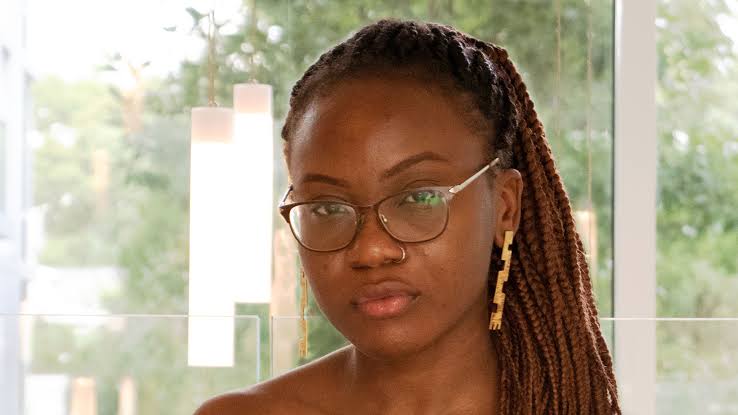
Gabonese artist Naila Opiangah is rapidly establishing herself as one of Africa’s most compelling contemporary artistic voices, earning international recognition for a body of work that explores identity, beauty, womanhood, and liberation through powerful depictions of Black female nudes.
Now living and working between Ghana and New York, the 31-year-old artist has attracted growing attention from collectors, cultural institutions, and influential figures in the worlds of art, fashion, and entertainment. Her paintings, characterized by a distinctive fusion of figurative and abstract techniques, challenge traditional narratives surrounding the female body while celebrating Black femininity in all its complexity.
Rebecca Enonchong Redefines Global Business Leadership as First African Woman ICC Vice-Chair
For Opiangah, art serves as both a deeply personal expression and a form of social commentary. Drawing from her experiences as an African woman navigating different cultural environments, she uses her work to question inherited perceptions of beauty, modesty, and self-expression.
“When asked how I see my work, whether it’s personal, political, spiritual, or all of the above, I see all of the above,” Opiangah has said. “But I would emphasize the fact that I find it political because I think it’s quite rebellious, given where I’m from, how I was raised, who I represent, and the community that I’m part of.”
Her artistic vision challenges attitudes toward nudity and the female body that she believes were shaped by colonial influences and continue to affect contemporary societies across Africa and beyond. Through vibrant compositions and emotionally charged imagery, Opiangah seeks to create space for conversations around freedom, autonomy, and representation.
The artist’s growing influence has extended beyond gallery walls and into the global fashion industry. Among her admirers are prominent cultural figures including rapper Chance the Rapper and renowned celebrity stylist Law Roach. Earlier this year, Roach brought Opiangah’s work to one of the world’s most prestigious fashion events, the Met Gala, showcasing a custom design that incorporated her artistic creations.
“My suit is in collaboration with a Ghanaian artist, Naila Opiangah,” Roach said. “She flew to Paris from Ghana to paint and create her works on this suit, and I’m so grateful.”
The high-profile collaboration introduced Opiangah’s work to a broader international audience and highlighted the increasing presence of African artists in global cultural conversations. It also underscored the growing influence of contemporary African art in shaping trends across fashion, design, and popular culture.
Opiangah’s journey to international recognition has been far from conventional. Born and raised in Gabon, she left her home country at the age of 18 to pursue studies in architecture in the United States. While her academic training provided a strong foundation in design and visual composition, her passion for painting developed independently. Entirely self-taught as an artist, she eventually transitioned from architecture to pursue a full-time career in the arts.
Today, her success reflects a broader shift in the global art market, where African artists are receiving increasing recognition for their contributions to contemporary culture. Yet Opiangah believes that true artistic growth on the continent depends on strengthening local ecosystems rather than relying exclusively on validation from Europe or North America.
“Yes, our work is recognised, celebrated, accessed by the West, but it’s equally recognised, celebrated and accessed by our people,” she said. “We need to have markets that are not just Western markets. We need to have markets that are local so that the development can be sustained.”
Her call resonates with ongoing efforts across Africa to expand support for local galleries, collectors, museums, and creative industries. Many artists and cultural leaders argue that building stronger domestic art markets is essential for ensuring sustainable growth and creating opportunities for future generations of African creatives.
As her profile continues to rise internationally, Opiangah remains committed to using her platform to inspire others, particularly young African women who may be considering careers in creative fields. Through her work and her journey, she hopes to demonstrate that success in the arts is possible regardless of background or geography.

With exhibitions, collaborations, and international recognition continuing to expand, Naila Opiangah is not only reshaping perceptions of African contemporary art but also helping to redefine what it means to be a global artist from Africa in the twenty-first century.