
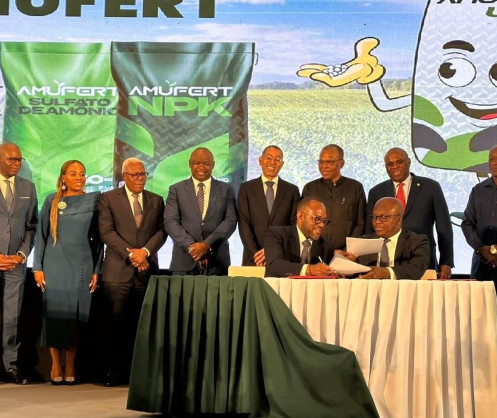
Angola is moving to strengthen its agricultural and industrial base with a major investment in domestic fertilizer production, as the African Export-Import Bank (Afreximbank) commits a $1.4 billion financing facility to the Ammonia and Urea Fertilizer (AMUFERT) plant in Soyo.
Afreximbank will serve as lead arranger and financial adviser for the project, while Angolan conglomerate OPAIA Group and state-owned Sonangol P&P Natural Gas (Sonagas) will act as sponsors. The project is being positioned as a major step toward reducing Angola’s dependence on imported agricultural inputs while making greater use of the country’s energy resources for domestic industrial development.
Faster Customs Clearance Speeds African Exports to China
The AMUFERT facility is expected to produce up to 3,870 tonnes of fertilizer per day when operating at full capacity, with production targeted to begin in early 2027. Angola currently imports more than $120 million worth of fertilizers each year to meet domestic demand, according to the information provided by the African Energy Chamber.
The development of a large-scale domestic production facility could significantly alter that dependence, providing farmers with a more reliable local source of fertilizer while reducing the costs associated with importing the product.
The project also reflects a broader effort to connect Angola’s energy sector with agriculture and manufacturing. By combining natural gas resources with fertilizer production, the Soyo plant is expected to create a link between the country’s energy infrastructure and its agricultural ambitions.
The African Energy Chamber has welcomed the financing agreement, describing the project as an important step toward energy security, agricultural self-sufficiency and economic diversification.
Beyond fertilizer production, the project is expected to generate employment and support the development of technical expertise and local supply chains. The plant could also contribute to technological development in Soyo and create opportunities for businesses involved in construction, logistics, maintenance and industrial services.
For Angola, the strategic importance extends beyond reducing fertilizer imports. A stronger domestic fertilizer industry could support efforts to expand agricultural production and improve food security by giving farmers greater access to essential agricultural inputs.
The participation of Afreximbank, OPAIA Group and Sonagas also underscores the increasingly important role of partnerships between African financial institutions, domestic companies and energy-sector operators in financing large industrial projects.
Afreximbank’s $1.4 billion commitment represents one of the largest financial components of the AMUFERT development and provides a significant foundation for the project as Angola seeks to translate its natural-resource wealth into greater domestic industrial capacity.
The project is also being viewed as part of Angola’s wider economic diversification agenda. Developing fertilizer manufacturing could allow the country to capture more value from its resources domestically while supporting sectors such as agriculture, manufacturing and logistics.

If completed as planned, the Soyo plant would place Angola among the African countries seeking to build stronger regional fertilizer production capacity and reduce exposure to international supply disruptions and import costs.
With production expected to begin in 2027, attention will now turn to construction, financing execution and the development of the infrastructure required to bring the facility into operation.