
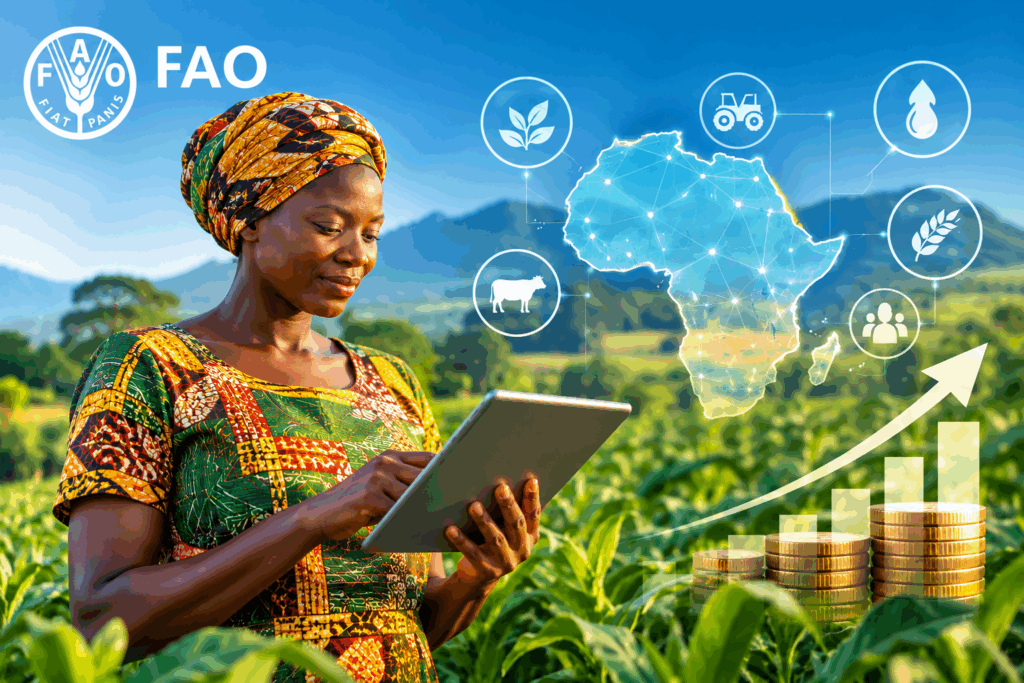
The Food and Agriculture Organization of the United Nations (FAO) has launched two new tools designed to help African governments improve how public resources are tracked and allocated across agrifood systems.
The tools were unveiled during a side event at the Africa Food Systems Forum 2026 in Kigali, Rwanda, as governments across the continent face growing pressure to finance agricultural and food-system priorities while managing limited public budgets.
The first tool, the Agrifood Systems Public Expenditure Analysis (ASPEA), provides a common framework for countries to define, classify and measure public spending across agrifood systems. According to the FAO, a standardized approach can improve the consistency of expenditure data, strengthen accountability and help governments monitor their public spending commitments.
The second tool, the Policy Optimization Tool (PolOpT), helps governments evaluate how existing resources could be distributed more effectively across policies and subsectors to support national development priorities. FAO analysis indicates that, in some cases, reallocating existing expenditure can produce greater results than simply increasing total spending.
FAO Deputy Regional Representative for Africa Meshack Malo said the tools are intended to provide practical support for governments in planning, budgeting, implementation and accountability. He also called on African governments, the African Union, Regional Economic Communities, development partners, financial institutions and research organizations to work with FAO to expand their use across the continent.
The tools are expected to support countries implementing the Comprehensive Africa Agriculture Development Programme (CAADP) Kampala Strategy and Action Plan 2025–2035, which provides a framework for advancing agricultural transformation and food security in Africa.
The ASPEA methodology was developed by economists from FAO’s Agrifood Economics and Policy Division and the FAO Investment Centre. It is designed to give policymakers and researchers a broader view of how public resources are distributed throughout agrifood systems.
PolOpT complements this expenditure tracking by using country-specific economic modelling to develop alternative spending scenarios. These scenarios allow policymakers to examine trade-offs between agricultural, economic, social and environmental objectives while working within existing fiscal constraints.
Rwanda has already begun applying the approach. Agriculture and Animal Resources Minister Telesphore Ndabamenye validated the results of FAO’s PolOpT analysis and approved the tool for use in the country. The results are expected to be shared with other government institutions, including the Office of the Prime Minister, the Ministry of Finance and Economic Planning and relevant line ministries.
FAO has also applied PolOpT in Burkina Faso, Ethiopia, Ghana, Mozambique, Nigeria and Uganda. In Nigeria, analysis from the tool has contributed to the country’s National Agrifood Systems Investment Plan for 2026–2027.

The launch highlights a growing focus on making existing public spending more effective, transparent and aligned with Africa’s food security and agricultural transformation priorities.