
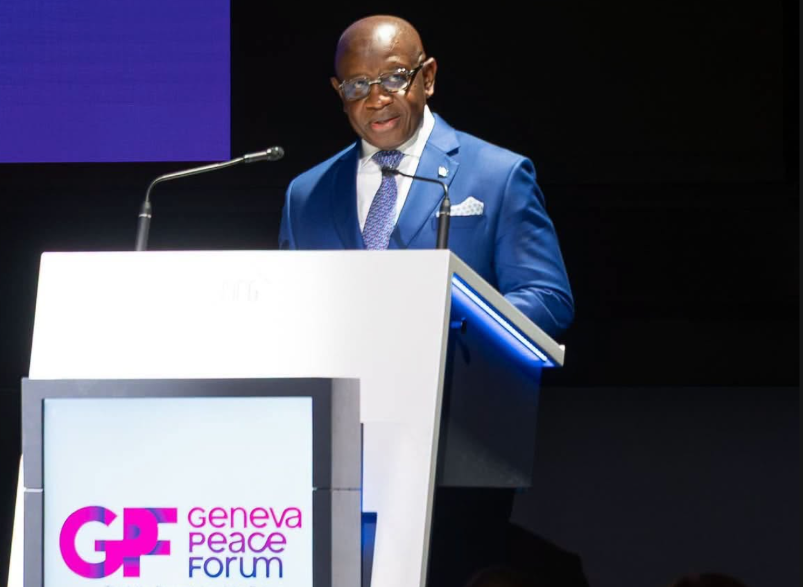
Sierra Leonean President Julius Maada Bio has called on world leaders to make conflict prevention a central priority of international cooperation, urging governments to invest more heavily in early intervention rather than focusing primarily on rebuilding countries after wars have erupted.
Digitalization and AI Take Center Stage on World Tourism Day in Equatorial Guinea
Speaking at the inaugural Geneva Peace Forum on 12 October 2026, under the theme “Choose Peace,” Bio proposed a “Geneva Commitment to Prevention,” a framework encouraging governments to progressively increase the share of international assistance allocated to preventing conflict and introduce transparent mechanisms for tracking early warnings and the actions taken in response.
Addressing delegates at the International Conference Centre Geneva, the president argued that the international community has developed significant experience in managing the consequences of war but continues to underinvest in measures that could prevent violence before it begins.
Drawing on his experience as a former military officer and Sierra Leone’s head of state, Bio stressed that sustainable peace requires political commitment, early action and institutions capable of addressing grievances before they escalate into conflict.
Sierra Leone’s own history formed a central part of his argument. The country’s civil war left deep social and economic scars, demonstrating that the end of armed hostilities does not automatically deliver reconciliation or lasting stability. When the country declared the war over in January 2002, the challenge shifted towards rebuilding institutions, restoring trust and helping affected communities recover.
The establishment of the Truth and Reconciliation Commission and the Special Court for Sierra Leone reflected efforts to address the legacy of violence through accountability and reconciliation. For Bio, the country’s experience illustrates why peacebuilding must extend beyond disarmament and reconstruction to include justice, inclusion and long-term investment in communities.
He pointed to ongoing conflicts in Sudan, the Sahel, eastern Democratic Republic of Congo, the Middle East and Ukraine as evidence of the devastating consequences when political tensions and warning signs are not addressed effectively.
Bio also highlighted emerging pressures that can deepen instability, including climate-related disasters, cyberattacks, the misuse of artificial intelligence and misinformation. He called for fairer climate financing, responsible technology governance, stronger education systems, expanded opportunities for young people, independent justice systems and credible elections.
The proposed Geneva Commitment to Prevention would seek to strengthen accountability by encouraging governments and international partners to explain how early warnings are translated into action. Such an approach could help make prevention a measurable part of international assistance rather than a principle invoked only after violence has escalated.
Bio also argued that Africa should be recognised as a source of experience and solutions in peacebuilding, rather than viewed only as a recipient of international assistance. Drawing on his regional experience as chair of the Economic Community of West African States, he called for African-led approaches supported by international cooperation.
He urged sustained engagement with Mali, Burkina Faso and Niger, emphasising the importance of dialogue and preserving connections between neighbouring countries whose populations share economic, social and regional interests.
The president’s message placed political inclusion at the heart of conflict prevention. Inequality, exclusion and declining public trust, he argued, can become warning signs when institutions fail to respond to citizens’ concerns. Addressing these problems early requires governments to create credible channels for dialogue and ensure that marginalised communities have a voice in decisions affecting their futures.
The Geneva Peace Forum’s focus on prevention comes amid continuing pressure on international institutions to respond to conflicts whose consequences extend far beyond national borders. Displacement, food insecurity, disrupted trade and humanitarian emergencies can affect neighbouring countries and place additional demands on regional and global institutions.
Turning Bio’s proposal into a practical international framework would require agreement on funding priorities, clear responsibilities and transparent ways to evaluate whether preventive measures are working. Early warning systems must also be connected to timely political action if they are to make a meaningful difference.

His central argument was that preventing war should be treated as a shared international responsibility, supported by sustained investment in diplomacy, accountable institutions and inclusive development. As Bio challenged leaders to act before crises become wars, he left the forum with a defining message: “Because the greatest victory of peace is not the war we end. It is the war we never allow to begin.”