
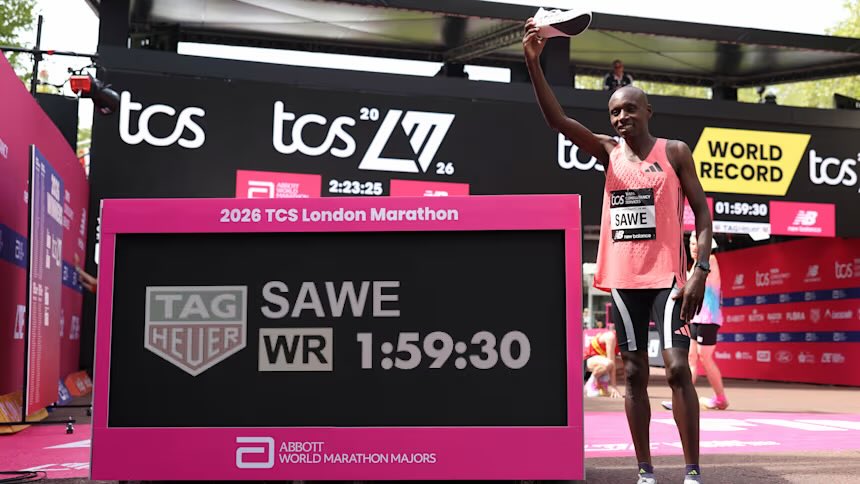
In a moment that reshaped the limits of human endurance, Sabastian Sawe became the first athlete to officially break the two-hour marathon barrier, clocking an astonishing 1:59:30 at the London Marathon.
The feat, long considered unattainable under official race conditions, marks a defining chapter in athletics, one that will be referenced for generations. Sawe did not just edge past history, he shattered it, beating the previous world record set by Kelvin Kiptum by a remarkable 65 seconds.
Seminar on Standardization and Certifications Highlights Push for Global Competitiveness
Even more striking was the depth of performance across the field, a rare moment when one historic run inspired others to push beyond perceived human limits. Ethiopia’s Yomif Kejelcha crossed in 1:59:41 in his marathon debut, while Uganda’s Jacob Kiplimo finished in 2:00:28, also faster than the previous world record.
Sawe’s performance was defined by discipline, control, and a devastating finish. After staying with the lead group through 30 kilometers, he gradually increased the pace, running negative splits, and completed the second half in 59 minutes and 1 second. In the final two kilometers, he broke away decisively, sprinting toward the finish line along The Mall to roaring crowds.
“This is not just for me,” Sawe said after the race. “It is for everyone who believed this was possible.” His words echoed across a sport that has spent decades chasing this elusive barrier.
The milestone inevitably invites comparison to Eliud Kipchoge, who ran 1:59:40 in 2019 during the INEOS 1:59 Challenge, a controlled, non record eligible event with rotating pacemakers and optimized conditions. Sawe’s run, by contrast, came in a standard race setting, making it the first officially recognized sub two hour marathon.
Observers say the psychological barrier may have been as significant as the physical one. For decades, the two hour mark stood as the ultimate frontier in distance running, comparable to the four minute mile in middle distance racing. Now, that frontier has been crossed in open competition.
Former champion Paula Radcliffe described the achievement as transformational, saying the goalposts have moved, capturing the sense that a new era in marathon running has begun.
The day also delivered excellence beyond the men’s race. Ethiopia’s Tigst Assefa defended her title in 2:15:41, the fastest ever recorded in a women only marathon, further cementing her dominance on the global stage.

Meanwhile, in the wheelchair events, Switzerland celebrated a double victory, with Marcel Hug claiming his sixth consecutive London title and Catherine Debrunner securing a hard fought win in the women’s race. What unfolded in London was more than a race. It was a redefinition of possibility. Records fell, barriers dissolved, and the sport stepped into a future that once seemed unimaginable.