
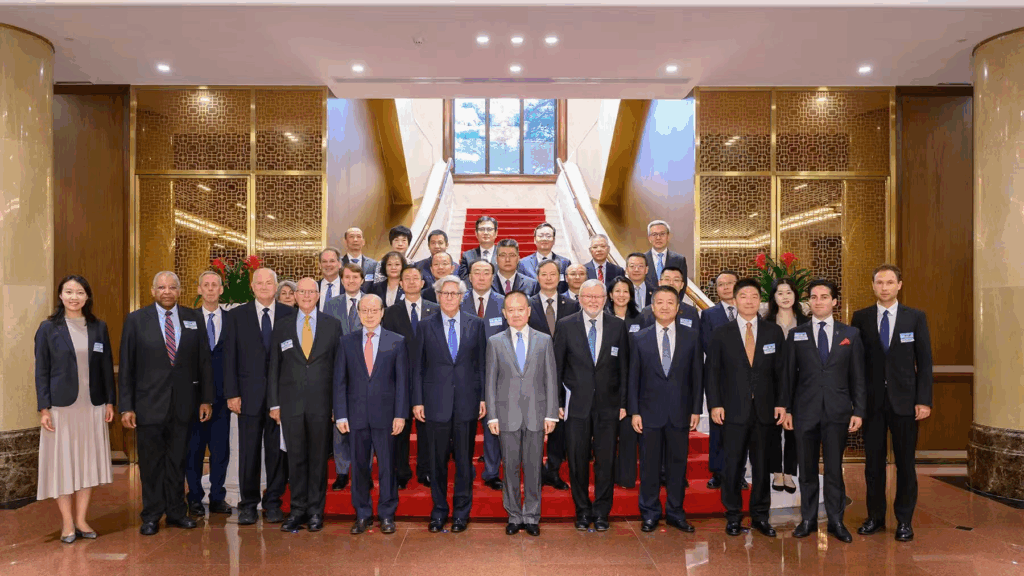
Chinese and US representatives met in Beijing on August 25 for the third China-US Track 1.5 Dialogue, focusing on ways to strengthen political trust, expand economic and trade cooperation and identify opportunities for collaboration in technology and artificial intelligence.
The discussions come as Beijing and Washington seek to establish what Chinese officials describe as a constructive relationship of strategic stability. Liu Haixing, head of the International Department of the Communist Party of China Central Committee, said the framework agreed by Chinese President Xi Jinping and US President Donald Trump during their May meeting provides strategic guidance for bilateral relations over the coming years.
China, Jordan agree to deepen development strategy alignment
The Track 1.5 format brings together government-linked officials, experts, business representatives and other stakeholders, creating a space between formal diplomatic discussions and non-governmental Track 2 dialogue.
John L. Thornton, co-chair of the Asia Society Board of Trustees, said the framework could create opportunities for progress in China-US relations. Craig Mundie, US co-chair of the China-US AI Track 2 Dialogue, similarly said participants were looking for practical areas where cooperation could be developed.
Trade and artificial intelligence were among the main issues discussed during the latest dialogue. Participants highlighted the importance of maintaining economic ties and avoiding a complete decoupling of the two economies.
Craig Allen, former president of the US-China Business Council, said business has historically been central to the bilateral relationship and argued that deeper engagement would benefit both sides.
A June report by the US-China Business Council found that 80% of surveyed US companies considered the Chinese market important or very important to their global competitiveness. Chinese customs data also showed that bilateral goods trade between China and the United States increased by 13.7% year on year during the second quarter of 2026.
Artificial intelligence emerged as another critical area for dialogue, with participants calling for greater cooperation to manage risks associated with rapidly developing AI technologies.
Christopher Nixon Cox, founder of the Nixon Dialogue and grandson of former US President Richard Nixon, said China and the United States should work together on AI safety and governance, warning that confrontation between the two countries over the technology could create risks for humanity.
The discussions also covered opportunities for cooperation in AI governance, youth programmes and other areas where practical engagement could help reduce tensions.
Chen Dongxiao, president of the Shanghai Institutes for International Studies, described the dialogue as sincere and constructive, with participants openly presenting their concerns and expectations while sharing information.
He expressed hope that proposals emerging from the discussions could be translated into concrete policy measures, particularly in AI governance and youth cooperation.
Liu Haixing called on China and the United States to maintain clear and consistent policy signals and address each other’s core concerns through equality, mutual respect and mutual benefit.

With 2026 regarded as an important year for China-US relations, the latest Track 1.5 Dialogue reflects continued efforts to identify areas of cooperation while managing competition and differences between the world’s two largest economies.