
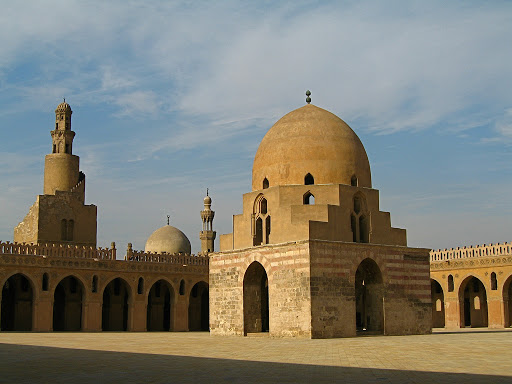
The second oldest mosque still standing in Cairo, Ibn Tulun Mosque, was built between AD 876 and 879 and modeled on the Kaaba in Mecca (Saudi Arabia). At the time it was built, it was the largest mosque in existence.
The Main Court’s colonnades have plentiful surviving fragments of intricate frieze work on display and open onto a series of narrow-fronted halls. The main prayer hall (on the southern side of the court) still holds onto fragments of its older decoration of carved stucco and wood, and the mihrab here has remnants of its original gold mosaic decoration.
On the mosque’s northern side is the 40-meter-high minaret with a fine horseshoe arch over the entrance and a spiral staircase swirling through the interior. It is modeled on the minarets of the Great Mosque of Samarra on the Tigris. If you climb the 173 steps up to its upper platform there are superb views extending over the sea of houses to the north, and to the Mokattam Hills in the east.
It’s an easy stroll from the Sultan Hassan Mosque to the Ibn Tulun Mosque walking straight down Al-Saliba Street.