
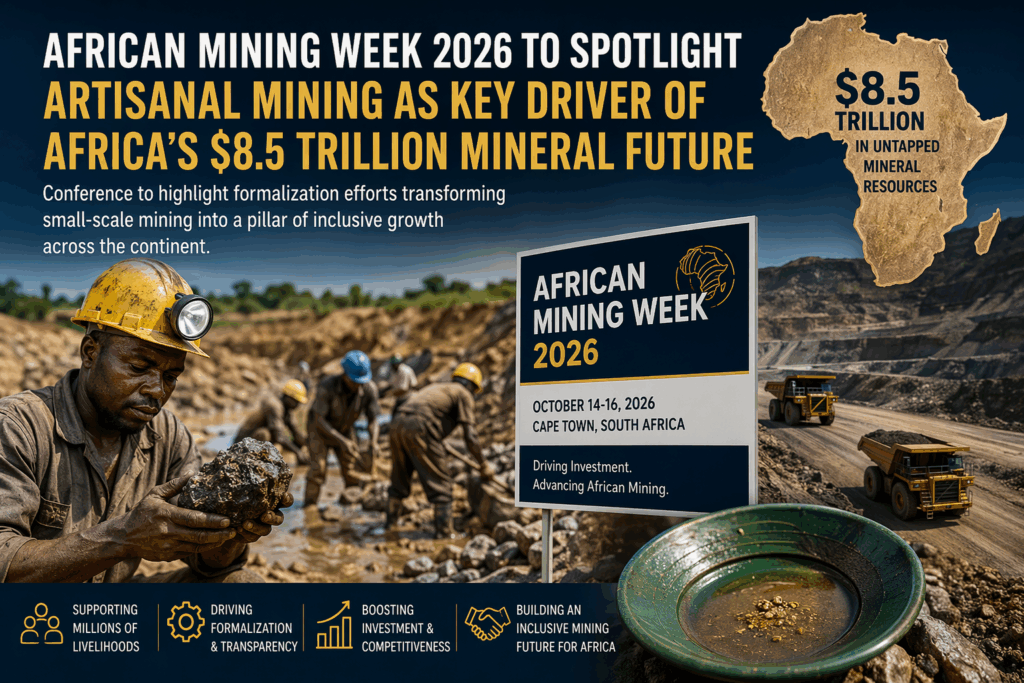
The upcoming African Mining Week 2026 will place artisanal and small-scale mining (ASM) at the center of discussions on how Africa can unlock its estimated $8.5 trillion in untapped mineral wealth.
Scheduled for October 14–16, 2026 in Cape Town, the conference is expected to bring together governments, investors, regulators and mining operators to explore strategies for formalizing a sector that supports millions of livelihoods across the continent but remains largely informal in many regions.
Equatorial Guinea Advances Bid to Become West Africa’s Gas Hub
A dedicated session titled “Accelerating the Formalization of ASGM” will examine how policy reforms, financing mechanisms and technology adoption can help integrate small-scale miners into formal value chains, improving productivity while ensuring greater transparency and environmental compliance.
Across Africa, governments are increasingly treating ASM not as a marginal activity but as a central component of national mining strategies. The push toward formalization is driven in part by the continent’s significant share of global critical minerals, estimated at around 30 percent.
In the Democratic Republic of the Congo, authorities have signed agreements aimed at integrating artisanal miners into the cobalt sector, a move designed to improve oversight and ensure that mineral wealth translates into broader economic and social benefits. The country remains the world’s largest producer of cobalt, a critical component in batteries and energy storage technologies.
In Zambia, reforms have focused on strengthening support systems for small-scale miners as part of a broader strategy to expand copper production to three million tons by 2031. A new legal framework has established a dedicated fund to support artisanal and small-scale mining operations, signaling a shift toward more structured participation in the sector.
Similar efforts are underway in gold-producing countries, where rising global prices have increased the urgency of formalization. Ghana, for example, has implemented initiatives such as the Ghana Gold Board and cooperative mining programs aimed at improving market access and technical capacity for small-scale operators. These measures come as artisanal gold exports have grown significantly, reflecting the sector’s expanding economic importance.
In the Democratic Republic of the Congo, additional reforms include the launch of a gold refinery intended to purchase output directly from artisanal miners and integrate it into formal supply chains. Complementary programs are also being implemented to provide financing and digital tools to improve efficiency and traceability in production.
International partners are also playing a role in supporting ASM transformation. The World Gold Council is working with several African countries to improve processing capacity and promote responsible mining practices, while development programs supported by European and United Nations institutions are investing in training, technical assistance and capacity building for miners across multiple countries.
As Africa seeks to harness its vast mineral resources for industrialization and economic development, ASM formalization is increasingly seen as a critical lever for inclusive growth.

By bringing small-scale miners into regulated systems, governments hope to boost revenues, improve safety standards and ensure that mineral wealth contributes more directly to local communities. Against this backdrop, African Mining Week 2026 is expected to serve as a key platform for advancing dialogue between policymakers, investors and industry stakeholders on the future of the continent’s mining sector.