
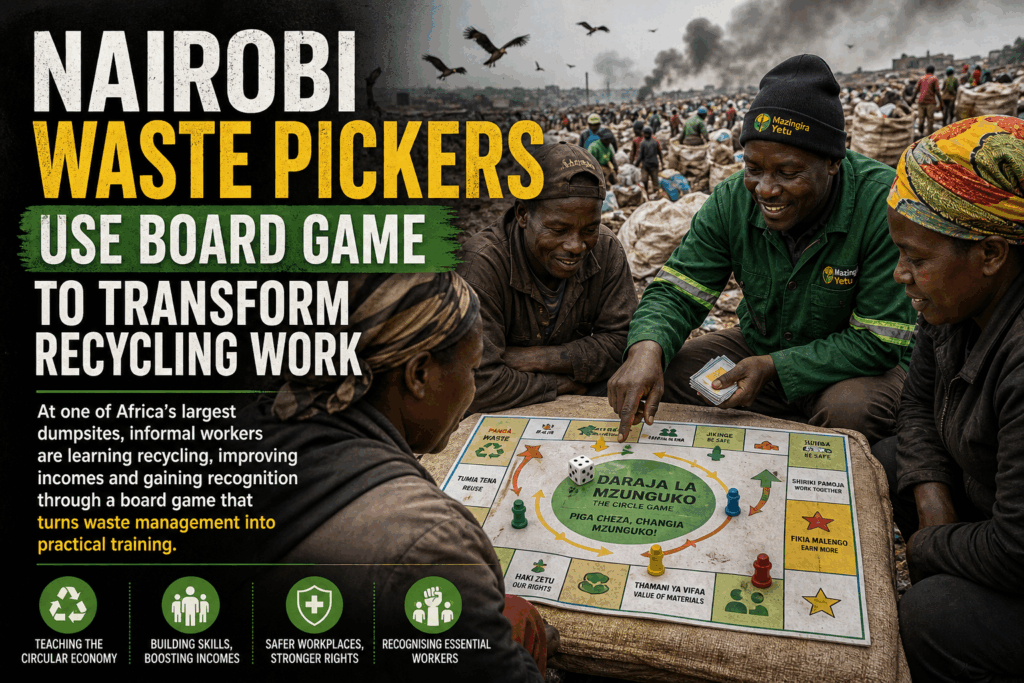
In Nairobi, amid the vast sprawl of the Dandora dumpsite, waste pickers are reshaping their role in the recycling chain not through machinery or policy, but through play. Surrounded by smoke, scavenging birds and mountains of refuse, thousands of informal workers sift through waste each day, salvaging anything of value. For many, it is a means of survival. Yet their labor quietly sustains a critical part of the urban economy, diverting significant volumes of recyclable material from landfills.
Despite their contribution, waste pickers often operate without formal training, protections or recognition. That gap has prompted the Mazingira Yetu Organization to introduce an unconventional solution: a board game designed to teach the principles of the circular economy.
Liquid Appoints New CEO to Lead Zambia Growth and Digital Expansion
The game transforms complex ideas into practical lessons. Players move across a board by rolling dice, landing on spaces that prompt discussion on topics such as waste sorting, reuse strategies, health protection and workers’ rights. The format encourages collaboration, debate and shared learning.
According to the Circularity Gap Report 2025, less than 10 percent of the more than 100 billion tonnes of materials used globally each year are recycled. Waste pickers, often working informally, account for a substantial share of what is recovered — underscoring their importance in the global effort to reduce waste.
For participants like Raphael Kung’u, who has worked at Dandora for three years, the training has shifted perspective. Materials once seen only as items to sell are now understood as resources with multiple uses and higher value potential.
Organisers say the game’s effectiveness lies in its accessibility. By incorporating Sheng — a widely spoken urban slang — it bridges the gap between technical language and everyday experience, allowing players to grasp and apply concepts more easily.
Experts note that game-based learning can be particularly powerful in informal settings. Hellen Dela of Greenpeace Africa said such approaches help workers better understand sorting systems, material value and sustainable practices, turning knowledge into practical action.

With global waste projected to rise sharply in the coming decades, the need for efficient, inclusive recycling systems is becoming more urgent. Data from the United Nations Environment Programme shows that municipal waste could reach 3.8 billion tonnes annually by 2050.
For Nairobi’s waste pickers, the board game represents more than a learning tool. It offers a pathway toward improved earnings, safer working conditions and a shift in perception — from invisible laborers on the margins to essential actors in building a more sustainable urban future.