
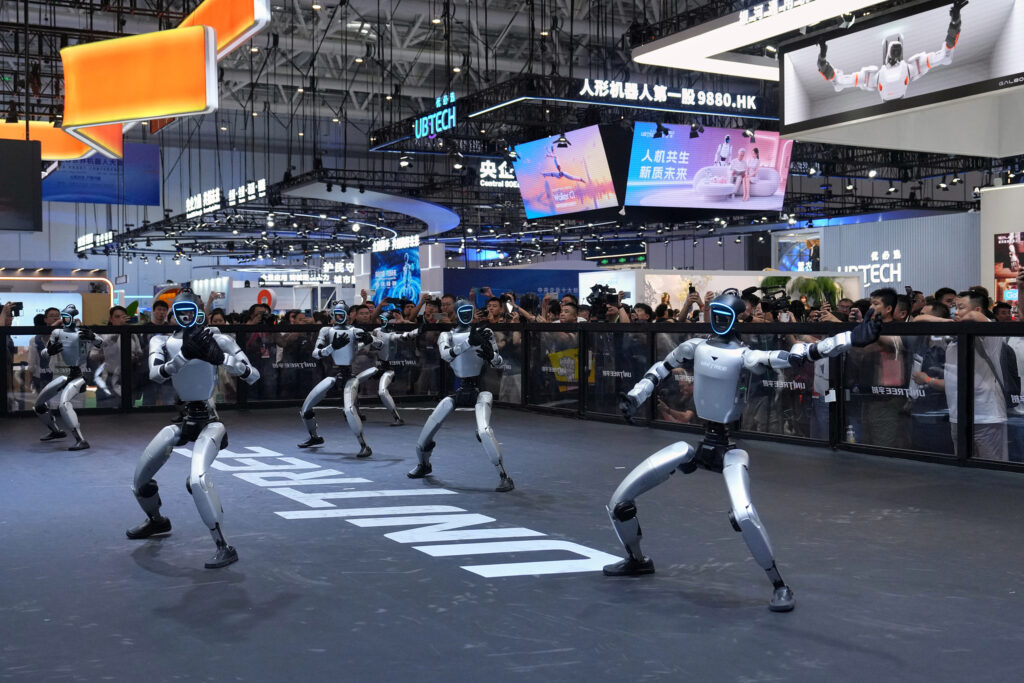
China’s humanoid robotics industry is entering a new phase as technological development increasingly intersects with financial markets, with investors showing strong appetite for companies expected to play a role in the commercialization of physical artificial intelligence.
Mozambique’s LNG restart puts gas and energy investment at the center of Africa’s energy future
The 2026 World Robot Conference, held in Beijing from Aug. 19 to 23, brought together more than 300 companies and displayed more than 2,000 robotic products, including over 150 new product launches. The scale of the event reflects the growing importance of robotics in China’s technology sector and comes as investors increasingly focus on the commercial potential of humanoid machines.
Unitree Robotics emerged as the most prominent example of that investor enthusiasm after its shares surged during their first day of trading on Aug. 19. The company priced its initial public offering at 150.80 yuan, or about $22.43, but its shares opened as high as 1,100 yuan before closing the morning session at 883.87 yuan, nearly five times the IPO price.
The surge pushed Unitree’s market capitalization to roughly $50 billion, highlighting the extraordinary expectations surrounding the future of humanoid robotics.
The performance was far above the average first-day gains recorded by new Chinese listings this year and has placed Unitree at the center of growing activity in the robotics capital market. Other Chinese robotics companies, including LimX Dynamics and Chery-backed AiMOGA Robotics, are also preparing for potential listings.
The enthusiasm is being driven in part by expectations that the humanoid robotics market will expand rapidly over the coming years.
Data from the China Academy of Information and Communications Technology shows that the global humanoid robot market reached 17 billion yuan in 2025, while China’s market exceeded 8.5 billion yuan, accounting for more than half of the global total.
Financial institutions are also increasing their focus on the sector. Morgan Stanley expects China’s humanoid robot market to reach $2 billion in 2026 and $15 billion by 2030. Its assessment suggests that the industry is moving beyond laboratory demonstrations and early-stage prototypes toward commercial applications, although widespread replacement of human workers remains a longer-term possibility.
Goldman Sachs has similarly identified several factors that could determine how quickly humanoid robots become commercially viable, including manufacturing scale, access to data, declining production costs and the efficiency of robots in real-world applications.
The investment bank forecasts that global humanoid robot shipments could reach 76,000 units in 2027 and 502,000 units by 2032. Large-scale deployment could begin emerging between 2027 and 2029, according to its projections.
The growing investor interest marks an important shift for the industry. Humanoid robots have traditionally attracted attention primarily because of their technical capabilities, including walking, running, manipulating objects and interacting with humans. The focus is increasingly moving toward whether those capabilities can be translated into sustainable businesses.
That transition will depend on several challenges. Manufacturers must reduce production costs, improve reliability and develop robots capable of performing useful tasks consistently in real-world environments. Companies will also need sufficient data and commercially viable applications to justify the industry’s rapidly rising valuations.
China’s position in the global robotics market gives its companies an important potential advantage. The country’s extensive manufacturing ecosystem provides access to industrial supply chains and production capabilities that could help robotics companies scale more quickly as demand develops.
For investors, however, the spectacular performance of robotics IPOs also highlights the risks of a young market. High valuations reflect expectations about future growth rather than established long-term profitability, meaning companies will ultimately need to demonstrate that technological progress can translate into recurring commercial demand.
The World Robot Conference offered a snapshot of that transition, with hundreds of companies showcasing technologies aimed at moving robotics from demonstrations into factories, businesses and other real-world environments.

For China, the stakes extend beyond individual companies. The development of humanoid robots is increasingly being linked to the country’s broader ambitions in artificial intelligence, advanced manufacturing and technological innovation.
The extraordinary market response to Unitree suggests that investors are already betting heavily on that future. The next test will be whether the technology can deliver the productivity, affordability and reliability needed to justify those expectations.