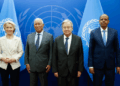
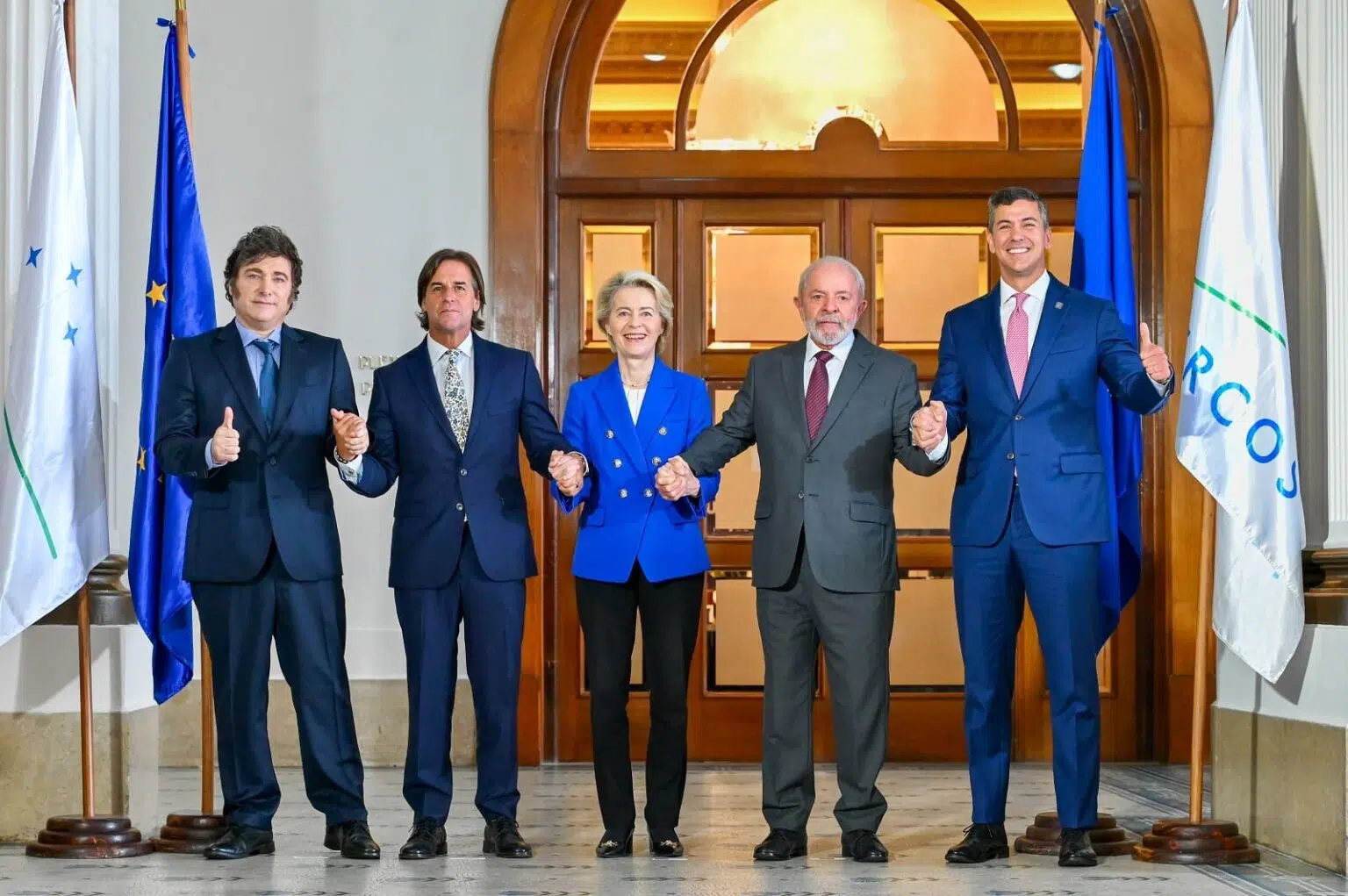
The European Union and the Mercosur bloc have formally signed a long-awaited trade agreement, paving the way for what both sides describe as the largest free trade area in the world. The deal was signed on Saturday in Asunción, Paraguay, bringing to a close more than two decades of negotiations. The signing ceremony took place in the presence of European Commission President Ursula von der Leyen and European Council President António Costa.
The agreement was endorsed by the leaders of Argentina, Paraguay and Uruguay, alongside the European Commissioner for Trade, Maroš Šefčovič. Brazil, a key supporter of the pact, was represented despite President Luiz Inácio Lula da Silva’s absence due to last-minute protocol changes.
Once fully implemented, the agreement will progressively remove tariffs on the vast majority of goods traded between the two blocs. According to the European Commission, duties will be eliminated on 91% of EU exports to Mercosur countries and on 92% of Mercosur exports to the European market. Together, the two blocs represent more than 700 million consumers and a combined gross domestic product of around $22 trillion.
Speaking ahead of the signing, Ursula von der Leyen described the agreement as a strategic and values-driven choice. “We are choosing cooperation over confrontation and long-term partnership over isolation,” she said, adding that the deal is intended to deliver concrete benefits for businesses, workers and consumers on both sides of the Atlantic.
António Costa echoed that message, framing the agreement as a counterweight to rising global protectionism. “At a time when some are building barriers, the European Union and Mercosur are building bridges,” he said, emphasising the importance of rules-based trade and fair competition.
AFCON 2025: Morocco and Senegal to Battle for Continental Glory
The agreement links two blocs comprising 31 countries and nearly a quarter of the global economy. It is expected to provide significant advantages to Mercosur’s agricultural exporters while opening long-protected South American markets to European industrial products, including machinery, vehicles and electrical equipment.
Negotiations between the EU and Mercosur formally began in 2000. A broad political agreement was reached in 2019, but technical, environmental and regulatory concerns delayed finalisation until December 2024. The deal has also faced opposition, particularly from European farmers who argue it could expose them to unfair competition from South American producers.
To address these concerns, the agreement includes safeguard mechanisms allowing either side to intervene if imports cause serious market disruptions or sharp price imbalances. Despite the formal signing, the accord will not take effect immediately, as it still requires ratification through legal and political procedures in both regions.
The deal comes amid heightened global trade tensions, including renewed trade disputes involving the United States, growing dependence on China, and the economic fallout from conflicts in Ukraine and the Middle East. These pressures, analysts say, helped push both sides toward compromise after years of stalled progress.
Some Mercosur countries, including Brazil, have signalled their intention to begin implementing parts of the agreement as early as the second half of the year, once domestic approval processes are completed.