
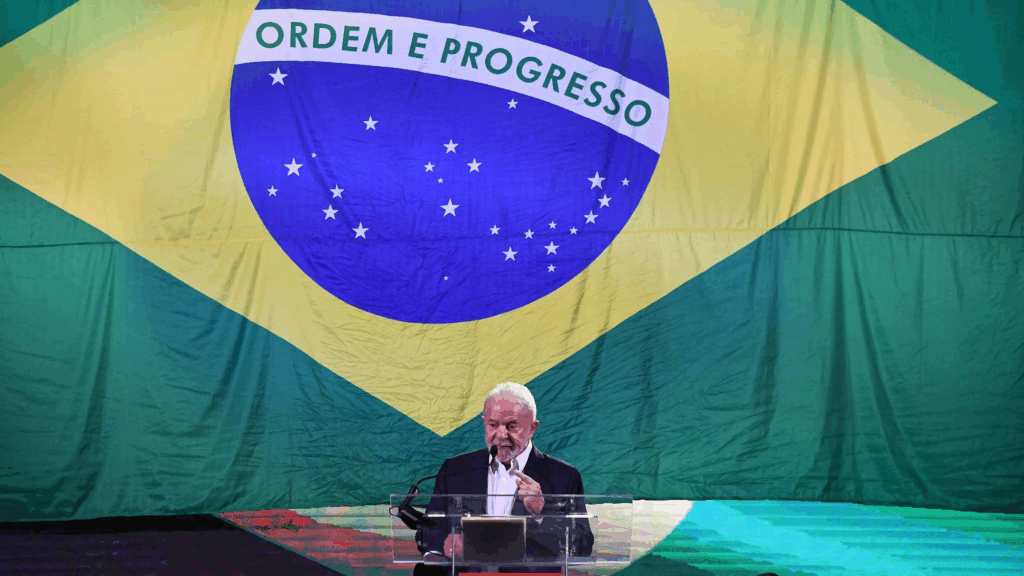
Brazilian President Luiz Inácio Lula da Silva has secured re-election after defeating opposition candidate Flávio Bolsonaro in the presidential runoff held on 25 October 2026, according to official results announced by the country’s Superior Electoral Court (TSE). The outcome extends Lula’s political leadership into a fourth presidential term and leaves Brazil facing the challenge of governing amid persistent political divisions.
With 100% of the votes counted, Lula, representing the Workers’ Party (PT), received 64,256,232 votes, equivalent to 51.79% of valid ballots. Flávio Bolsonaro, the Liberal Party (PL) candidate and son of former president Jair Bolsonaro, obtained 59,826,041 votes, or 48.21%, according to the TSE. The margin of approximately 4.43 million votes confirmed a closely fought contest between two candidates offering contrasting political directions for Latin America’s largest economy.
Speaking to supporters in São Paulo after the results were announced, Lula pledged to work with the conservative Congress elected by Brazilians and to encourage greater public participation in government decision-making. His victory comes after a first round on 4 October in which Flávio Bolsonaro finished ahead with approximately 47.03% of valid votes, compared with Lula’s 45.16%. Neither candidate secured the majority required to win outright, sending the election to a second round.
The runoff also highlighted the continuing political polarisation shaping Brazil’s democratic landscape. The contest centred on competing visions for the country’s economy, social programmes, public security and institutional direction, mobilising voters across different regions and social groups.
Following the announcement, Flávio Bolsonaro rejected the outcome, describing it as impossible to recognise and calling for the election to be annulled. His refusal to concede adds uncertainty to the immediate political aftermath, although the official results have been declared by the country’s electoral authority. Any challenge to the outcome will need to proceed through the relevant legal and electoral institutions.
Lula’s victory also follows a complicated election day. Reports indicated that voting hours were extended in some areas after requests from both campaigns amid transport difficulties and severe weather. The decision generated controversy and became part of the dispute surrounding the result. However, the TSE announced Lula’s re-election following the completion of the count.
The president-elect has also emphasised the importance of digital regulation and national sovereignty, arguing that Brazil must protect its democratic processes from foreign interference through digital platforms. The issue reflects wider international debates about online political influence, misinformation and the responsibilities of technology companies during elections.
Lula is scheduled to begin his new four-year term on 5 January 2027. He will face the task of building working relationships with a conservative Congress while addressing economic pressures and the expectations of voters who remain divided over the country’s political future.
For Brazil, the election represents more than a change in the balance of political support. It tests the capacity of democratic institutions to manage a disputed outcome through established procedures and provides a new mandate for a president who has remained a central figure in the country’s politics for decades.

As the transition approaches, attention will focus on whether political leaders can respect the electoral process, pursue legal challenges through institutional channels and reduce the divisions exposed by the campaign. The stability of Brazil’s democratic system will depend not only on the announcement of a result, but also on the willingness of political actors to engage with the institutions responsible for upholding it.