
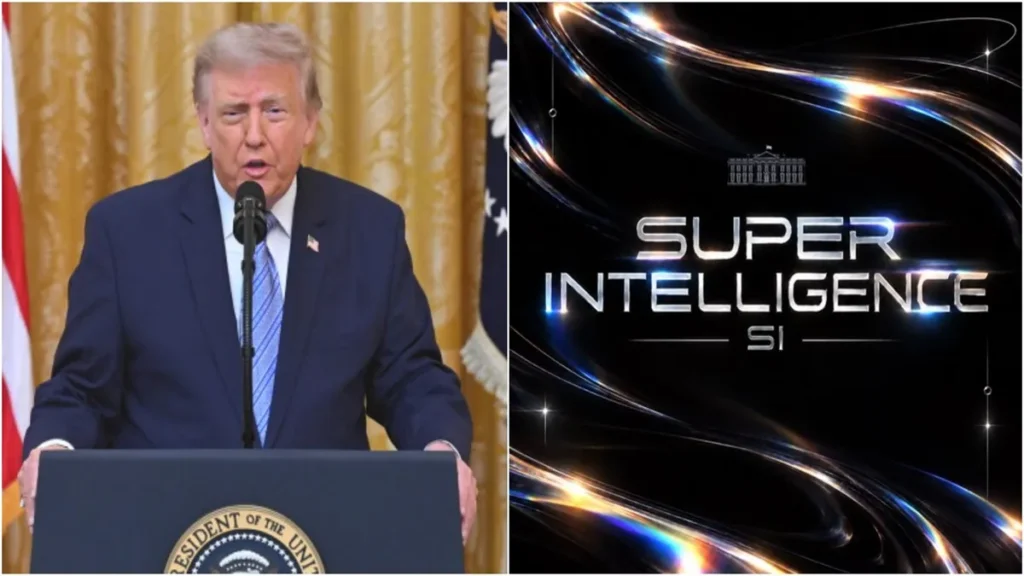
President Donald J. Trump has signed an executive order directing U.S. federal departments and agencies to use the terms “Super Intelligence” (SI) and “SI” instead of “Artificial Intelligence” (AI) in official government communications.
The executive order, signed on September 29, 2026, is titled “Inaugurating the Era of Super Intelligence.” It instructs executive-branch agencies, to the maximum extent permitted by law, to adopt the new terminology across official correspondence, public communications, websites, reports, policy documents and other non-statutory materials.
Mukuru Expands South Africa’s Digital Banking Market With New Everyday Account
The White House says the change reflects what it describes as the rapidly expanding capabilities of today’s advanced technology. According to the administration, the systems now being developed increasingly go beyond simply imitating or automating individual aspects of human intelligence, instead supporting new forms of creativity and problem-solving across fields including science, medicine, energy and manufacturing.
Trump had already promoted the terminology during his address to the 81st United Nations General Assembly in New York on September 22. During the speech, he argued that the word “artificial” made the technology sound less authentic and announced that U.S. documents would move toward the term “Super Intelligence.”
The executive order now gives that announcement formal policy status within the U.S. executive branch. Importantly, however, the order does not immediately create an entirely separate legal category of technology. It states that, for purposes of implementation, “Super Intelligence” and “SI” initially mean the technologies and systems covered by the existing federal definition of artificial intelligence under U.S. law. The administration has given its Assistant to the President for Science and Technology 60 days to propose a federal definition that could eventually modify or expand that framework.
The terminology shift comes as the Trump administration is also seeking a broader role for the United States in the development and deployment of advanced computing technologies. The White House says more than $5 billion in federal funding has been announced for the Genesis Mission, a national initiative intended to use advanced intelligence technologies to accelerate research in areas including science, medicine, energy and manufacturing.
The change is already generating discussion beyond Washington. U.S. diplomats were instructed earlier in September to replace references to artificial intelligence with “Super Intelligence” in their communications following Trump’s United Nations remarks.
The terminology also intersects with an international conversation about the future of advanced technology. While “superintelligence” has long been used in academic and technology circles to describe hypothetical or emerging systems capable of surpassing human intellectual capabilities across a broad range of tasks, the Trump administration is using the expression more broadly for technologies currently covered by the established AI definition.
For Africa, the terminology may be less important than the underlying technological transformation. Governments, universities, businesses and young innovators across the continent are increasingly engaging with AI-related applications in education, healthcare, agriculture, finance, public services and creative industries. As major technology powers reshape their policies and definitions, African countries will also face questions about how to build digital capacity, participate in emerging technology markets and establish frameworks that reflect their own development priorities.

Trump’s executive order therefore represents more than a change in vocabulary inside the U.S. government. It places a new label at the centre of an expanding global conversation about the capabilities, opportunities and governance of advanced intelligence technologies.
For now, AI remains the established technical and legal terminology in much of the world, while the U.S. executive branch begins its transition toward “Super Intelligence” and “SI.” The administration’s proposed federal definition, expected within 60 days, could provide a clearer indication of whether the initiative ultimately represents a change in terminology, a broader policy framework, or both.