
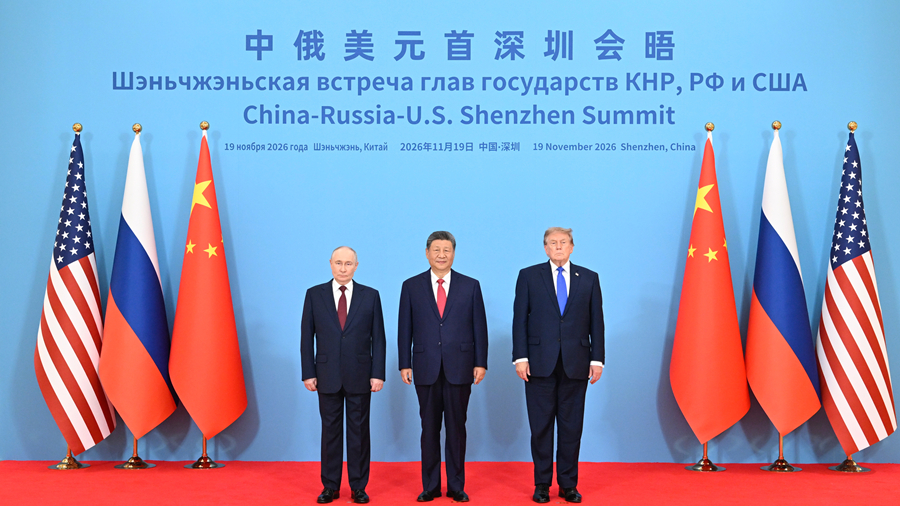
Chinese President Xi Jinping, Russian President Vladimir Putin and US President Donald Trump held an unprecedented trilateral summit in Shenzhen, southern China, on November 19, 2026, bringing together the leaders of three major global powers for discussions on international security, geopolitical tensions and global stability.
The meeting took place amid ongoing regional conflicts, growing strategic competition and uncertainty over the future of the international order. It provided a rare opportunity for the three leaders to engage directly on issues affecting global peace, despite their countries’ significant differences.
During the discussions, Xi recalled the cooperation between China, Russia and the United States during the Second World War, when they stood together as key forces against fascism. He argued that relations between major powers have far-reaching consequences for international stability, stressing that cooperation and peaceful coexistence are essential to preventing wider conflict.
Following the summit, the three leaders issued a joint document titled the China-Russia-US Heads of State Declaration toward Peace, outlining four areas of intended cooperation.
The declaration commits the three countries to pursuing reform of the United Nations to improve its ability to respond to global challenges. It also calls for increased production and supply of refined petroleum products, reaffirming the importance of stable energy flows.
Another provision emphasises state consent and immunity for government officials, while expressing concern that the International Criminal Court and similar institutions should not exceed their jurisdiction. The fourth point reaffirms that nuclear war cannot be won and must never be fought, with the three countries committing to dialogue on reducing nuclear risks and preventing nuclear proliferation.
DIALOGUE AS A FOUNDATION FOR STABILITY
Xi described the international community as a global community with a shared future, arguing that major powers carry particular responsibilities because their decisions affect countries far beyond their borders. He stressed that constructive interaction between major countries is not optional but necessary.
The summit also highlighted the existing relationship between China and Russia, which has developed through cooperation in trade, energy, investment, security and people-to-people exchanges. Both countries maintain institutional mechanisms for regular diplomatic and economic engagement.
China-US relations were another important dimension of the discussions. Throughout 2026, the two governments have pursued diplomatic engagement and economic consultations aimed at establishing a more stable relationship based on mutual respect, fairness and reciprocity.
Their economic discussions have included arrangements for establishing a Board of Trade and a Board of Investment, intended to provide structured channels for addressing commercial issues and improving bilateral engagement. The first meeting of the Board of Trade has already taken place, while an agricultural working group is expected to hold its inaugural meeting.
As permanent members of the United Nations Security Council, China, Russia and the United States have considerable influence over international security decisions. Xi called on the three countries to work together to address global challenges and contribute to international peace and development.
UKRAINE AND THE CHALLENGE OF MAJOR-POWER RELATIONS
The Ukraine conflict and nuclear security remain important areas of concern in relations between Washington and Moscow. According to the summit coverage, the United States and Russia have maintained high-level and working-level contacts during 2026 concerning a possible political settlement, nuclear arms control and strategic stability.
China has continued to advocate a political resolution through dialogue and negotiations, maintaining communication with Russia, Ukraine and other relevant parties.
Putin described international peace as a shared responsibility of the three countries and argued that addressing regional conflicts appropriately serves their common interests. Trump also emphasised the importance of dialogue in maintaining stability and resolving disputes.
However, the joint declaration did not outline a specific settlement framework for Ukraine or establish a new nuclear arms-control agreement. Its commitments on nuclear issues were centred on future dialogue to reduce risks and prevent proliferation.
Sun Taiyi, a professor at Christopher Newport University in the United States, told CGTN that the summit was historically significant because it created a direct channel for the three major powers to discuss their shared responsibility for strategic stability despite their differences.
Zhang Tengjun, an associate research fellow at the Institute of American Studies of the Chinese Academy of Social Sciences, said Xi’s four principles for major-power relations — mutual respect, peaceful coexistence, win-win cooperation, and dialogue and consultation — were interconnected and reflected the changing dynamics of international relations.
A HISTORIC MEETING, BUT WHAT COMES NEXT?
The Shenzhen summit represents a significant diplomatic moment, bringing together the leaders of China, Russia and the United States in a format never previously held at the presidential level. Its significance extends beyond the symbolism of the encounter, given the three countries’ influence over nuclear security, energy markets, international institutions and global economic relations.
Nevertheless, the declaration’s broad commitments leave important questions unanswered. It does not establish detailed implementation timelines or a new framework for resolving the conflicts that continue to affect international security. The absence of specific agreements on Ukraine and a new nuclear arms-control arrangement also underlines the limits of the meeting’s immediate outcomes.

The summit has therefore opened an additional channel for dialogue, but its long-term impact will depend on whether the three governments translate their commitments into practical cooperation and sustained diplomatic engagement.
Xi described the meeting as positive, constructive and fruitful, expressing the view that prospects for peace remain as long as dialogue continues and diplomatic channels remain open.