
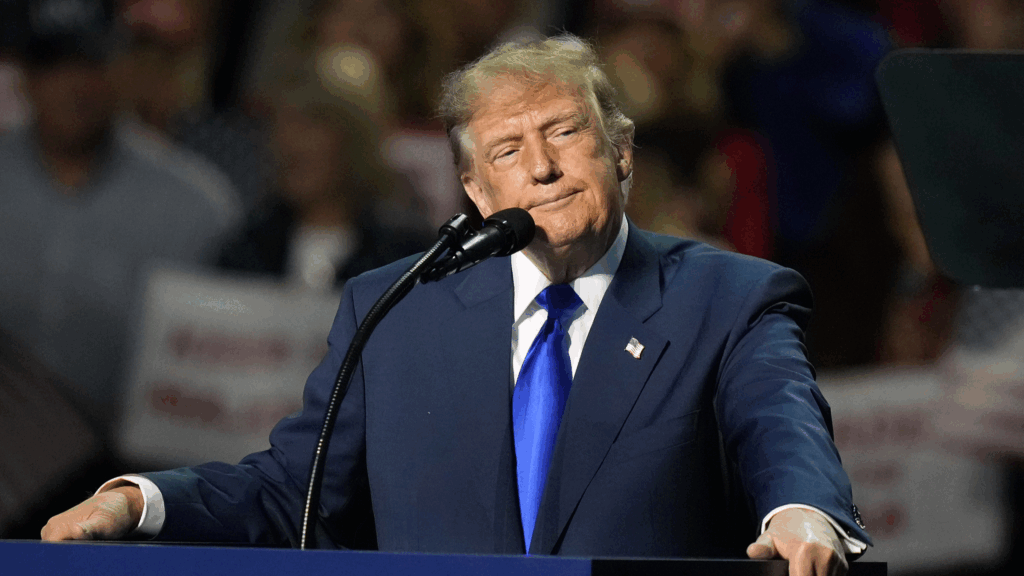
US President Donald Trump has said the war with Iran will end “immediately after” the US midterm elections in November, as renewed fighting around the Strait of Hormuz intensifies pressure on global energy markets and raises concerns about the conflict’s potential duration.
Trump made the remarks on Wednesday as the conflict entered its seventh month, with renewed clashes near the strategic waterway contributing to a rise in oil prices. Brent crude futures surpassed $100 a barrel for the first time since July, reflecting growing concerns over disruptions to energy supplies and shipping.
US-Canada Tariff Fight Raises Supply Chain and Economic Risks
Trump said oil prices would decline once the conflict ends, while acknowledging that negotiations with Tehran remain possible. However, he indicated that negotiations were not his preferred approach and argued that Iran would struggle to withstand continued US economic pressure.
The US midterm elections are scheduled for November 3 and are expected to be an important political test for the Trump administration. The conflict and rising living costs have emerged as issues affecting public sentiment toward the president.
Trump’s prediction that the war would end shortly after the elections contrasts with warnings reportedly issued by some senior US officials. According to a Wall Street Journal report citing US officials, Vice President JD Vance and Secretary of State Marco Rubio have privately warned that Iran could continue resisting US pressure, potentially extending the conflict beyond the current US presidential term in January 2029.
The latest escalation has involved a series of attacks near the Strait of Hormuz, one of the world’s most important energy shipping routes. The US military said it destroyed five Iranian oil tankers following an Iranian attack on a US warship, while Iran’s Islamic Revolutionary Guard Corps said it conducted retaliatory strikes against two US warships and eight US oil tankers. US Central Command denied that its naval vessels had been attacked.
Iran’s Foreign Ministry condemned the US strikes, saying Iranian forces had conducted defensive operations against US military facilities and vessels. Tehran said it would continue responding to what it described as US military aggression.
The conflict has also affected commercial shipping through the Strait of Hormuz. Preliminary data from ship-tracking company Kpler showed that only six commercial vessels passed through the waterway on Wednesday, below both the previous day’s figure and the recent average.
Iranian Revolutionary Guard Corps spokesperson Hossein Mohebbi warned that Tehran retained the ability to respond to attacks and could launch broader strikes if targeted. He also outlined conditions for ending the conflict, including a halt to military operations, an Israeli withdrawal from Lebanon, the lifting of the blockade on Yemen, the release of frozen Iranian assets and an end to pressure on Iran’s nuclear and missile programmes.
Mohebbi further announced that Iran would establish a new maritime “sanctions zone”, under which vessels entering the area could face restrictions affecting maritime services and insurance.

With the conflict continuing to affect energy prices, shipping and regional security, uncertainty remains over whether Trump’s prediction of an end to the war after the US midterm elections will materialise or whether the confrontation will continue for a longer period.