
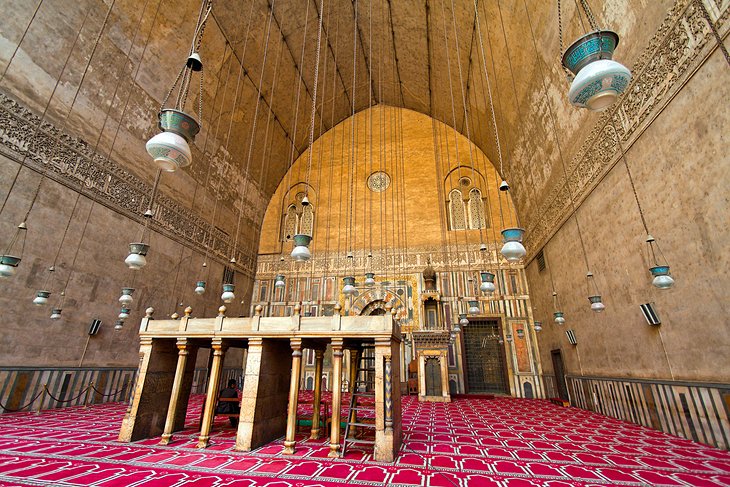
One of the finest examples of Mamluk architecture in the world, Sultan Hassan Mosque is a vision of Arabic artistry with an abundance of stalactite detailing and intricate arabesque features. It was built in 1356-63 for the Sultan Hassan el-Nasir.
The exterior, with its large areas of stone, is reminiscent of an ancient Egyptian temple. The massive main doorway at the north corner is almost 26 meters high, and the minaret at the south corner is the tallest in Cairo at 81.5 meters.
The main doorway leads into a domed vestibule, beyond which are a small antechamber and a corridor leading into the ornate open Court centered around an ablution fountain. From here, an iron door leads into the sultan’s mausoleum where the stalactitic pendentives of the original dome still survive. In the center of the chamber is the sultan’s simple sarcophagus.
Directly facing the Sultan Hassan Mosque is the El-Rifai Mosque, built in 1912 to house the tomb of Khedive Ismail and constructed to replicate its older next door neighbor. The ex Shah of Iran, Mohammed Reza Pahlavi (1919-1980), is also buried here.
Both mosques prominently sit on Midan Salah ad-Din, directly below Cairo’s Citadel.