
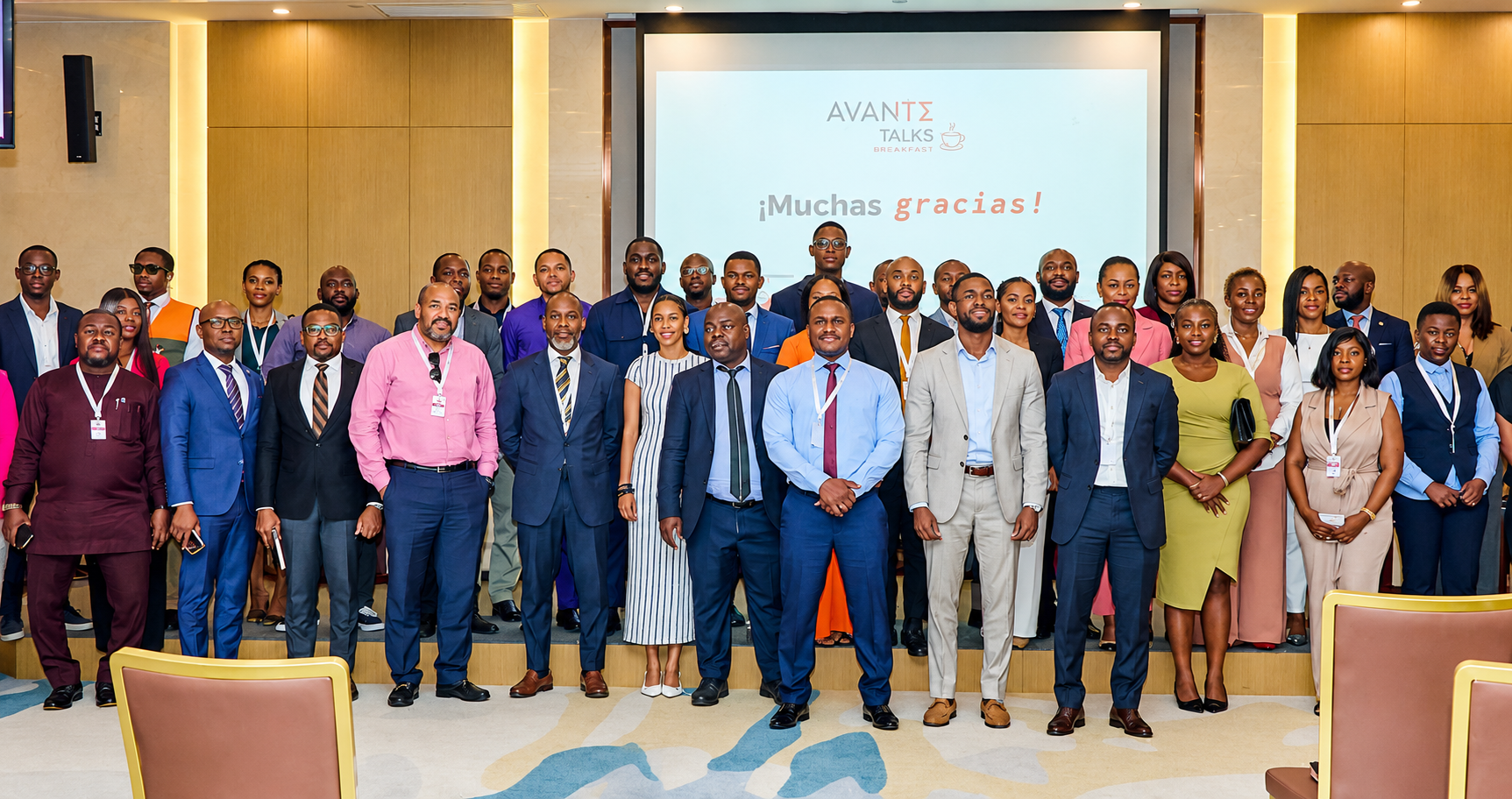
The second edition of AVANTE Talks Breakfast transformed a business gathering in Malabo into one of the most direct and revealing conversations currently taking place about the future of entrepreneurship in Equatorial Guinea. Hosted on May 20 at the Hotel Anda China by AVANTE, the event convened entrepreneurs, executives, institutional representatives and professionals under the theme “Entrepreneurship and Startups: Building a Sustainable Ecosystem for National Development.” Far from becoming another ceremonial business conference centered on optimism and startup buzzwords, the gathering evolved into a detailed examination of the structural weaknesses slowing private sector growth in the country.
The discussion featured keynote speaker César Bolobaha, founder of Situcka, alongside panelists Rafael Mayer and Dionisia Alogo. Together, the speakers addressed the growing pressures facing a nation attempting to diversify its economy beyond hydrocarbons while simultaneously trying to cultivate a generation of entrepreneurs capable of sustaining long-term economic transformation.
Morocco Secures €200M to Expand Skills and Youth Employment
The event also reinforced AVANTE’s growing role as a platform for strategic dialogue around leadership, business development and economic modernization in Equatorial Guinea. Its first edition, held in March under the theme “Women Leaders: Innovation and Transformation from the Female Perspective,” featured contributions from M. Dolores Tung Eyang, Angela Mba and Silvia Carmen Ebang, signaling the initiative’s broader ambition to create sustained high-level conversations around the country’s economic future.
This latest edition focused heavily on the realities confronting entrepreneurs operating in Equatorial Guinea today.
Throughout his keynote intervention, César Bolobaha repeatedly returned to the argument that Equatorial Guinea does not yet possess a fully functioning entrepreneurial ecosystem, despite having many of the ingredients necessary to build one. According to him, the country’s institutions continue operating independently from one another, creating fragmentation between education systems, financing structures, logistics, mentorship and business support services. He argued that ecosystems are not built through isolated projects or occasional startup initiatives, but through coordinated systems capable of connecting entrepreneurs with the resources, technical knowledge and institutional support required to sustain business growth over time.
Bolobaha nevertheless emphasized that Equatorial Guinea retains several major structural advantages that many developing economies still lack. He pointed to the country’s political stability, strategic location, existing infrastructure and natural resources as foundations that could support long-term private sector development if properly leveraged. Yet he warned that much of the formal economy continues to depend heavily on public spending and oil-related industries, while entrepreneurs attempting to solve practical market problems often face far greater barriers to growth and survival. In one of the strongest moments of the discussion, he reminded participants that economic activity itself depends on stability, declaring that “without peace, there is no business.”
Much of the conference concentrated on the growing disconnect between the country’s education system and the actual demands of the labor market. Bolobaha criticized what he described as an overproduction of administrative and theoretical academic profiles while technical expertise remains severely underdeveloped in strategic sectors. He argued that the country urgently needs to prioritize technical education in areas such as mathematics, engineering, mechanics, technology and industrial sciences if it hopes to support serious economic diversification in the future.
To illustrate the problem, Bolobaha shared Situcka’s experience operating electric bicycles financed through a green economy initiative supported by the United Nations Development Programme. Despite successfully securing financing and equipment, the company reportedly struggled to find qualified local mechanics capable of maintaining the bicycles properly. As a result, many eventually became unusable. According to him, the situation exposed a deeper structural contradiction within the national economy: infrastructure and imported technologies are arriving faster than the country is developing the human capital necessary to sustain them. He noted that foreign technicians continue occupying positions in workshops and technical operations throughout the city because the local system has not produced enough specialized workers capable of filling those roles.
Bolobaha also stressed that innovation strategies in Equatorial Guinea must remain connected to the country’s actual economic priorities rather than simply copying startup models imported from abroad. He argued that entrepreneurship should align with productive sectors identified under the national Agenda 2035 framework, including agriculture, fisheries, logistics, construction, energy and tourism. In his view, genuine innovation is not about replicating foreign digital trends disconnected from local realities, but about creating practical solutions that directly address domestic economic needs and generate measurable value inside the country.
During his intervention, Rafael Mayer focused heavily on the relationship between entrepreneurship, financing and institutional trust. He explained that while entrepreneurs often describe access to capital as one of their greatest challenges, financial institutions themselves also operate under significant levels of uncertainty and risk. According to Mayer, weak judicial enforcement mechanisms and prolonged commercial disputes continue undermining confidence among lenders and investors, making financial institutions far more cautious about supporting startups and emerging businesses.
Mayer argued that investment decisions are ultimately built on institutional credibility and legal predictability. Without efficient dispute resolution systems and stronger protections around contracts and repayments, he warned that both domestic and foreign investment will remain constrained. He explained that judicial delays and institutional insecurity frequently discourage long-term financing because investors struggle to calculate or control risk within unstable enforcement environments.
At the same time, Mayer highlighted the importance of professional networks and strategic relationships in accelerating entrepreneurial growth. He argued that entrepreneurs frequently underestimate the value of their personal and professional connections, despite the fact that strong networks often reduce operational costs, facilitate partnerships and accelerate problem-solving. In his view, business growth depends not only on financial resources but also on access to people capable of opening opportunities, sharing expertise and creating strategic collaborations.
Mayer also rejected the notion that Equatorial Guinea can achieve economic transformation while remaining isolated from international talent and expertise. He argued that countries increasingly compete not only to attract investment capital but also to attract highly skilled professionals capable of transferring knowledge and accelerating innovation ecosystems. According to him, attracting international expertise while simultaneously developing local talent will become essential if the country hopes to diversify successfully beyond oil dependency.
Another important dimension of the discussion centered on entrepreneurial discipline and execution. Both Mayer and Bolobaha emphasized that many business failures in Equatorial Guinea stem not necessarily from weak ideas, but from poor operational consistency and weak long-term management practices.
Bolobaha stated that entrepreneurs in the country often excel at planning and presenting ideas but struggle to maintain disciplined execution over extended periods. He argued that investor confidence is not created through presentations, motivational speeches or startup branding campaigns, but through resilience, operational stability and measurable long-term performance. According to him, entrepreneurs who survive difficult market conditions and remain operational for years naturally reduce investor perceptions of risk because they demonstrate reliability through sustained execution rather than promises alone.
The conversation also addressed the financial habits of entrepreneurs themselves. Bolobaha openly acknowledged that one of the most damaging mistakes he made during his early years as a business owner was mixing personal finances with company finances. He explained that the practice eventually created accounting disorder and complicated future access to investors and financing opportunities. His admission resonated with many participants because it highlighted the extent to which entrepreneurship requires not only creativity and ambition, but also financial discipline, structure and organizational maturity.
Another topic discussed during the conference was whether young entrepreneurs should abandon stable employment in order to fully dedicate themselves to startups. Mayer adopted a more cautious perspective, particularly given the current financing environment in Equatorial Guinea. He explained that maintaining full-time employment can provide entrepreneurs with financial security while allowing them to gradually build and stabilize their businesses over time. According to him, entrepreneurship should not always be approached through unnecessary financial risk when long-term sustainability remains uncertain.
As the event concluded, AVANTE Talks Breakfast succeeded in doing something still relatively rare within many business forums across the region: creating an honest conversation about the deeper realities shaping entrepreneurship in Equatorial Guinea. Rather than presenting entrepreneurship as a fashionable slogan or a quick solution to economic diversification, the speakers repeatedly framed it as a long-term structural process requiring institutional reform, technical education, financial discipline, stronger execution and coordinated national strategy.
For AVANTE, the conference reinforced its role not merely as an event organizer, but as a platform attempting to shape the national conversation around business and economic transformation at a moment when Equatorial Guinea faces mounting pressure to redefine its economic future beyond oil and gas.