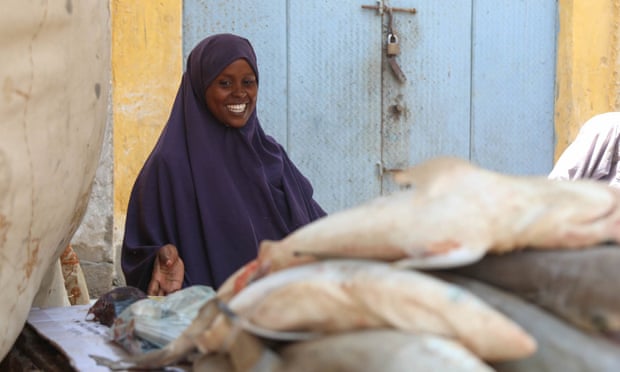
Like most women in this business, she depends on men to catch the fish. Men dominate the fishing sector. It is considered “men’s work” in Somali society. But Ahmed is determined to push her way in.
“They say it is men’s work,” she says. “They don’t trust that we are strong enough to run a boat or manage a business. They want us to sell things like milk on the roadside or stay at home.”
Ahmed was introduced to the industry by a friend, and she soon discovered that other women were challenging stereotypes, switching from selling milk and tea, which could pay for a day’s food, to selling fish, which could pay for food and help cover school fees.
“It was like a door of hope had opened for me in the sea,” she says. “I was hesitant at the beginning but I now feel empowered.”
To pay rent for a space in the market and to buy an icebox to store her fish, Ahmed took out a $300 (£246) loan from Kaah International Microfinance Service (Kims), the first privately owned microfinance institution in Somalia, when it opened in 2014. She has been able to gradually expand her business.
“I pay back $25 every month,” she says. “Kims has been extremely helpful in laying the foundation for my business. I now focus on acquiring other crucial skills like fish-drying, marketing and building new customers.”
With funding from the UK’s Department for International Development, Kims provides sharia-compliant financial support to people on low-incomes throughout Somalia.
“We have supported 25,000 female-owned businesses since we began operating in 2014,” says Khalif Yusuf, Kims regional manager in Kismayo. “We particularly prioritise women in the fishing sector since they have proven to be competitive and created employment opportunities for other fellow women.”
Ahmed is one of 70 members of a women’s cooperative in Kismayo’s fishing sector, supported by Kims. The cooperative employs 10 young women who receive training and mentorship while at the same time earning income with a view to starting their own business in the future.
Some of the women are now earning $200 a month, compared with about $50 before joining the sector. It’s not been easy, though. Ahmed and other women in the cooperative have received abuse from men for doing their work. Men tell the women they are too weak to sail a boat to catch fish, or that they are embarrassing their families.
Somali women make up 56% of the population, but generate up to 70% of household income, according to government figures. However, they are highly underrepresented in the formal labour force.
“In addition to lack of investment and favourable public policy, Somali women face cultural barriers that dictate what type of business they can or cannot do,” says Idil Abdulkadir Hussein, the Kismayo-based director of Somali Peace Development Initiatives. “Therefore, men take advantage of these cultural norms and block women who try to join the businesses they traditionally dominate.”
Ahmed’s family fled the capital, Mogadishu, after the civil war erupted in the early 1990s. When her father died, her mother started selling dry food rations. Like most girls from poor backgrounds, Ahmed was married when she was 16 and had her first child by the time she turned 17. She never had the opportunity to go to school.
“Education was not a priority for us at the time,” she says. “But I want my children to get all the opportunities that I have missed in life. It is not going to be easy but I will try my best as long as I am alive and if I die I will leave them to God.”
Somalia has the longest coastline in Africa, stretching more than 2,000 miles (more than 3,300km) and has been historically exploited by illegal foreign vessels. In 2019, however, for the first time in more than 20 years, the country issued official fishing licences to foreign companies, generating more than $1m.
The Ministry of Fisheries and Marine Resources, which signed an agreement with 31 Chinese vessels, said the revenue collected from offshore licensing would be used to improve the domestic fishing sector.
Ahmed wants to take advantage of that potential opportunity to expand her business.
“I want to buy a boat and compete with men,” she says. “I believe if we get reliable access to investment we can build a sustainable economy for our community.”
News is under threat …
… just when we need it the most. Millions of readers around the world are flocking to the Guardian in search of honest, authoritative, fact-based reporting that can help them understand the biggest challenge we have faced in our lifetime. But at this crucial moment, news organisations are facing an unprecedented existential challenge. As businesses everywhere feel the pinch, the advertising revenue that has long helped sustain our journalism continues to plummet. We need your help to fill the gap.
We believe every one of us deserves equal access to quality news and measured explanation. So, unlike many others, we made a different choice: to keep Guardian journalism open for all, regardless of where they live or what they can afford to pay. This would not be possible without financial contributions from our readers, who now support our work from 180 countries around the world.
We have upheld our editorial independence in the face of the disintegration of traditional media – with social platforms giving rise to misinformation, the seemingly unstoppable rise of big tech and independent voices being squashed by commercial ownership. The Guardian’s independence means we can set our own agenda and voice our own opinions. Our journalism is free from commercial and political bias – never influenced by billionaire owners or shareholders. This makes us different. It means we can challenge the powerful without fear and give a voice to those less heard.
Reader financial support has meant we can keep investigating, disentangling and interrogating. It has protected our independence, which has never been so critical. We are so grateful.