
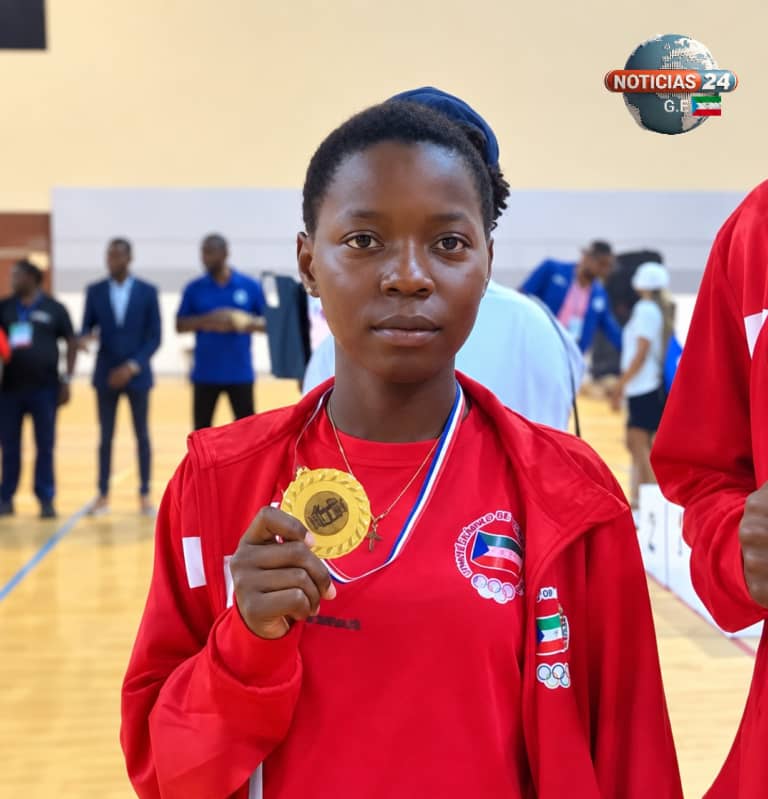
Equatorial Guinea is celebrating a significant milestone in international chess as national champion Justa Mbasogo Eyama Oye reaches the points requirement for the Woman Candidate Master (WCM) title during the 45th FIDE Chess Olympiad in Samarkand, Uzbekistan.
Mbasogo has collected 3.5 points from her first six games, reaching the 50 percent scoring requirement applicable to the WCM performance at the Women’s Olympiad. With one game still to play, she is now within reach of completing the minimum seven-game requirement associated with the achievement.
Africa Pushes for a Bigger Global Role as Unstoppable Africa 2026 Opens
According to the National Chess Federation of Equatorial Guinea (FENAGE), Mbasogo’s performance makes her the first Equatorial Guinean female chess player to reach the requirements for the WCM title, marking a new chapter for the country’s women’s chess movement.
The achievement is particularly significant because the FIDE Chess Olympiad brings together players representing national teams from around the world. Competing in such an international environment gives Equatorial Guinean players the opportunity to test their skills against a wide range of opponents while gaining valuable experience at one of chess’s major global events.
For Mbasogo, the milestone builds on her position as Equatorial Guinea’s current national champion. Her progress in Samarkand demonstrates the development of a player who has already established herself at home and is now making her mark on an international stage.
The WCM achievement is also part of a larger ambition. Mbasogo is targeting the Woman FIDE Master (WFM) title, which requires a higher performance level.
Under the criteria cited by FENAGE, players competing in the Women’s Olympiad need to score at least 65 percent of the available points across a minimum of nine games for the WFM performance. For Mbasogo, this means reaching six points after nine games.
With 3.5 points already secured after six rounds, she needs to collect at least 2.5 additional points from her next three games to reach the six-point target.
That challenge gives the final stages of her Olympiad campaign an added dimension. Having already reached the WCM points threshold, Mbasogo now has an opportunity to build on her performance and pursue another international milestone.
Her achievement is also drawing attention to the wider development of women’s chess in Equatorial Guinea. National champions such as Mbasogo provide greater visibility for the sport while demonstrating the potential for Equatorial Guinean players to compete beyond domestic tournaments.
Chess requires strategic planning, concentration and the ability to adapt quickly to changing positions, making international competition an important part of a player’s development. The experience gained in Samarkand can therefore contribute not only to Mbasogo’s own career but also to the broader experience available within Equatorial Guinea’s chess community.
The 45th FIDE Chess Olympiad is providing the setting for this historic moment, with Samarkand bringing together chess talent from across the world. For Equatorial Guinea, Mbasogo’s campaign has placed the country’s women’s chess programme in an international spotlight and created a new reference point for aspiring players.
Her journey also follows a broader pattern in African sport, where athletes and competitors are increasingly using international competitions to establish new benchmarks for their countries. In Equatorial Guinea, Mbasogo’s performance offers another example of national sporting talent making progress on a global platform.
As she prepares for her next game, the immediate objective is clear: complete the required seven games and consolidate the WCM milestone. Beyond that, the reigning national champion has a further target in sight — six points after nine games and the possibility of reaching the performance requirement for the Woman FIDE Master title.
Whatever the outcome of the remaining rounds, Justa Mbasogo has already created a notable moment for Equatorial Guinea’s women’s chess, becoming the country’s first female player to reach the WCM requirements at the FIDE Chess Olympiad and opening a new chapter in the nation’s chess story.