
Africanian
  • Home
  • News
  • News 24/7
  • Business
  • Sports
  • World
    • US
    • Russia
    • Europe
    • Asia
    • America
  • Events
No Result
View All Result
Africanian
  • Home
  • News
  • News 24/7
  • Business
  • Sports
  • World
    • US
    • Russia
    • Europe
    • Asia
    • America
  • Events
No Result
View All Result
Africanian
Home Health

End hunger: A future where insects make up a substantial portion of the world’s diet is on the horizon.

Animal protein derived from cows, chicken and pig takes up 80 percent of the entire world's farmland, despite only making up less than one-fifth of calories consumed globally.

End hunger: A future where insects make up a substantial portion of the world's diet is on the horizon.
Share on FacebookShare on TwitterShare via Whatsapp

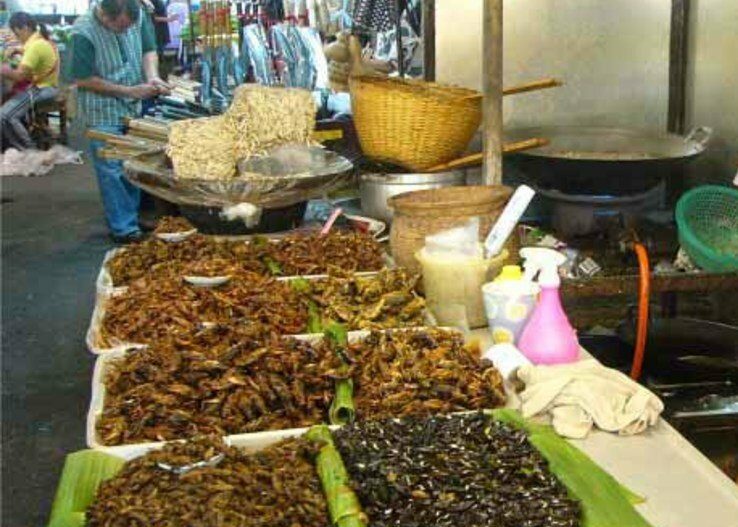
Despite the squeamish nature of such cuisine, insects have been considered a delicacy in some parts of world for centuries. Their low-fat and high-protein nutritious profiles make them a perfect candidate to reduce famine, alongside having a host of environmental benefits.

Animal protein derived from cows, chicken and pig takes up 80 percent of the entire world’s farmland, despite only making up less than one-fifth of calories consumed globally. By freeing up livestock space, huge expanses of land across the world could be returned to native ecosystems, supporting a spectrum of biodiversity as nature intended.

READ MORE: Addis Ababa: China commits to peace mediation in Horn of Africa

Invertebrates such as grasshoppers, mealworms and crickets are packed full of protein with much higher vitamin levels than pork or beef. They require little space, water and technology to raise compared to large megafauna mammals, which are often pumped full of medication and antibiotics contributing to the global antibiotic resistance crisis. Greenhouse gas emissions through this process are also negligible, with insect waste making excellent fertiliser for agricultural soil.

What seems to be a miracle solution for many issues plaguing the world today is, however, hampered by the challenge of making insects palatable as a cuisine in cultures around the world.

READ MORE: South Africa: President Cyril Ramaphosa mourns for 22 teenagers dead in tavern

Urban areas of Asia, Europe and North America are most likely to associate insects with dirt instead of as a palatable meal, which is surprising given the popularity of marine invertebrate cuisine. Shrimps, crab and lobsters produce similar visual dishes to crickets and grasshoppers, with their many legs, antennae and small sizes seemingly tolerated. Lobsters are especially prized in Western cooking, a far cry from the dish’s origin of having filthy connotations from being served as a prison food.

How a dish is perceived, from disgusting to gourmet, can change dramatically with time and clever marketing.

Prussian leaders of the 18th century famously grew potatoes in a royal field patrolled by guards, cleverly utilizing reverse psychology to woo local peasants into eating the nutritious vegetable, previously regarded with suspicion.

READ MORE: Ghana: African Development Fund approves $27.19 million grant for skills development infrastructure to boost post Covid-19 recovery

Times are changing. The European Union last year declared that mealworms were safe for human consumption, triggering many startups to leap into action, all racing to produce palatable products for a new healthy and green-conscious market.

Cricket protein powder is also surging in popularity, with Canada rapidly becoming the largest market for the commodity. Said to have a mild nutty taste, cricket protein can be sprinkled over porridge or combined to create food textures that do not resemble creepy crawlies for the squeamish.

READ MORE: African Development Bank Group urges G7 countries to support Africa’s emergency food production plan

The sakondry insect from Madagascar, fast becoming a national staple, is said to be so crispy on the outside and meaty on the inside that it closely resembles fried bacon cubes, without the excessive saturated fat.

A future where insects will become invaluable to space exploration is also imminent.

As we explore our solar system, efficient means of producing animal based-proteins will become vital. None are more efficient space-wise than insects, and the colonies of the future could well find themselves tucking into fried crickets with a pint of beer while watching the Martian sunset.


Source: China Daily

RelatedPosts

Algeria: $2.8 Billion and 495 km to transform the Sahara

Algeria: $2.8 Billion and 495 km to transform the Sahara

November 20, 2025
DR Congo marks hope with youngest Ebola patient’s recovery

DR Congo marks hope with youngest Ebola patient’s recovery

November 10, 2025
Zambia accelerates its energy transition with a 20 MW solar power project

Zambia accelerates its energy transition with a 20 MW solar power project

November 3, 2025
80,000 tons of “Made in Africa” Titanium to redefine the continent’s Industrial future

80,000 tons of “Made in Africa” Titanium to redefine the continent’s Industrial future

October 31, 2025
Cameroon accelerates polio response with local sequencing

Cameroon accelerates polio response with local sequencing

October 28, 2025
Africa strengthens global gas leadership as Philip Mshelbila becomes GECF Secretary General

Africa strengthens global gas leadership as Philip Mshelbila becomes GECF Secretary General

October 27, 2025
Medical teams contain Ebola in Bulape and renew hope in the DRC

Medical teams contain Ebola in Bulape and renew hope in the DRC

October 25, 2025
Republic of Congo strengthens Ebola preparedness as DR Congo faces new outbreak

Republic of Congo strengthens Ebola preparedness as DR Congo faces new outbreak

October 15, 2025
Ghana emerges as China’s new economic focus in West Africa

Ghana emerges as China’s new economic focus in West Africa

October 15, 2025
Africanian News Is a dedicated project aimed at amplifying the voices of the African Ecosystem and Diaspora. We actively collaborate with initiatives to improve access to education and digital inclusion, both in traditional schools and through digital platforms, for African children.

It’s crucial to emphasize that none of the articles or images featured on our platform are intended for copyright infringement, neither now nor in the future.
If you believe that any information, text, image, etc., may be subject to copyright and should be removed, please notify us by sending an email to: [email protected]

News Categories

  • America (39)
  • Asia (131)
  • Business (1,232)
  • Culture (227)
  • Destinations (210)
  • Europe (153)
  • Food and Drink (14)
  • Guides & Tips (20)
  • Health (629)
  • Hotels (5)
  • Meetings and Tech (349)
  • News (2,534)
  • Opinion Piece (12)
  • Russia (73)
  • Science (62)
  • Sports (311)
  • Style (4)
  • Travel (145)
  • US (107)
  • World (422)

Your dreams matter; your stories matter.

Feel free to explore collaboration opportunities with us. Share your articles, thoughts, interviews, experiments, or no-comment videos by reaching out to [email protected].

You can also subscribe to our mailing list to receive the latest updates from Africanian News.

Newsletter

© 2025 Africanian News.

Log In

Sign In

Forgot password?

Don't have an account? Register

Forgot password?

Enter your account data and we will send you a link to reset your password.

Back to Login

Your password reset link appears to be invalid or expired.

Log in

Privacy Policy

Accept

Add to Collection

  • Public collection title

  • Private collection title

No Collections

Here you'll find all collections you've created before.

No Result
View All Result
  • Home
  • News
  • Business
  • Sports
  • Meetings and Tech
  • World

© 2025 Africanian News.