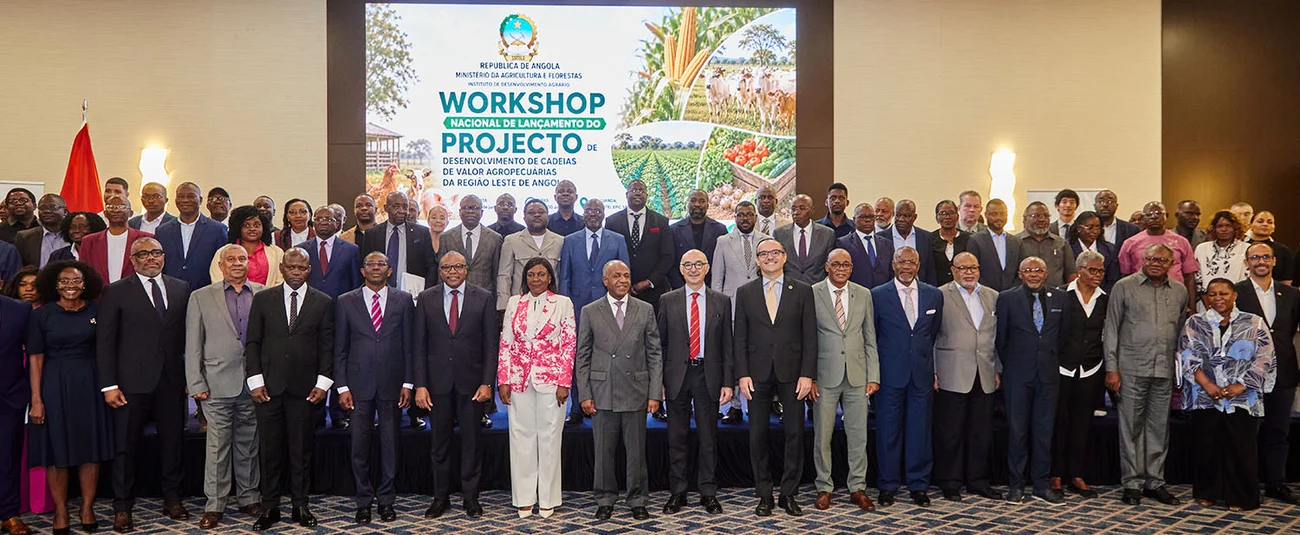
Angola has launched the Eastern Region Agricultural Value Chain Development Project, a strategic initiative aimed at accelerating agricultural productivity, strengthening rural economies and reducing the country’s dependence on food imports.
Launched on 16 July 2026, the project is expected to reach approximately 240,000 households, representing around 1.2 million people, with women and young people among its key beneficiaries.
Angélique Kidjo Makes History as First Black African to Receive Hollywood Walk of Fame Star
The initiative places Angola’s eastern region at the centre of efforts to build a more modern, resilient and market-oriented agricultural sector. It will support value chains covering cereals, beans, soybeans, groundnuts, cassava, coffee, cocoa and palm oil, while placing particular emphasis on wheat and rice production.
By increasing domestic production of these crops, Angola aims to reduce its reliance on imports while creating stronger opportunities for smallholder farmers to connect with markets, technology, finance and private investment.
The project’s location also gives it strategic importance. Eastern Angola sits within the wider economic network connected to the Lobito Corridor, creating opportunities to improve agricultural logistics, expand market access and attract investment into production and processing.
Speaking at the launch ceremony, Angola’s Minister of Agriculture and Forestry, Isaac dos Anjos, described the initiative as an important step in the country’s agricultural transformation.
“The launch of the Eastern Region Agricultural Value Chain Development Project marks an important milestone in the transformation of Angola’s agricultural sector,” dos Anjos said.
He said the government was working to give farming families greater access to knowledge, technology, finance and markets, enabling them to move from largely subsistence agriculture towards more productive and commercially oriented farming.
The minister also highlighted the project’s potential to generate income, create jobs and improve living conditions in rural communities.
“Our partnership with the African Development Bank is essential to accelerating this transformation and ensuring that agriculture continues to serve as one of the country’s main engines of economic development,” he said.
The African Development Bank’s Country Representative in Angola, Pietro Toigo, said the institution was supporting Angola at a critical stage in unlocking the agricultural potential of its eastern region.
“The African Development Bank is proud to support Angola at this decisive stage in unlocking the enormous agricultural potential of the Eastern Region,” Toigo said.
According to the AfDB, the project will combine infrastructure, technical expertise, innovation and private-sector development to create sustainable agricultural value chains.
For Angola, the initiative forms part of a broader push to diversify its economy beyond oil and build agriculture into a stronger source of employment, industrialisation and inclusive economic growth.
The Eastern Region Agricultural Value Chain Development Project therefore represents more than an investment in farming. It positions Angola’s agricultural sector as a potential driver of food security, rural development, private investment and long-term economic diversification.