Japanese citizens gathered near the United States Embassy in Tokyo on Wednesday evening to protest the alleged killing of a local woman by a US Marine stationed in Okinawa, while also opposing an upcoming joint military exercise between Japan and the United States.
The demonstration reflects renewed public anger over the presence of US military bases in Okinawa, where residents have long raised concerns about crime, safety and the impact of hosting a substantial share of US military facilities in Japan.
According to a report by China Global Television Network (CGTN), protesters chanted slogans including “US military bases out of Okinawa” and “US military, stop killing.” Police officers and patrol vehicles were deployed to maintain order, with some pushing and shoving reported between demonstrators and police.
One protester, identified as Ishiyama, described the incident as horrifying and argued that Okinawa’s residents had carried an unfair burden in the name of Japan’s national security. Another participant, Matsumoto, said the continued presence of US troops in the prefecture contributed to concerns about the risk of similar incidents.
The protests followed the arrest of Devin Ballard, a 20-year-old US Marine stationed at Marine Corps Air Station Futenma. Okinawa prefectural police arrested him on 4 October in connection with the suspected killing of a local woman at a hotel in Naha, the prefectural capital, on 3 October. He is also suspected of stealing the woman’s wallet and other belongings. The allegations remain subject to the legal process.
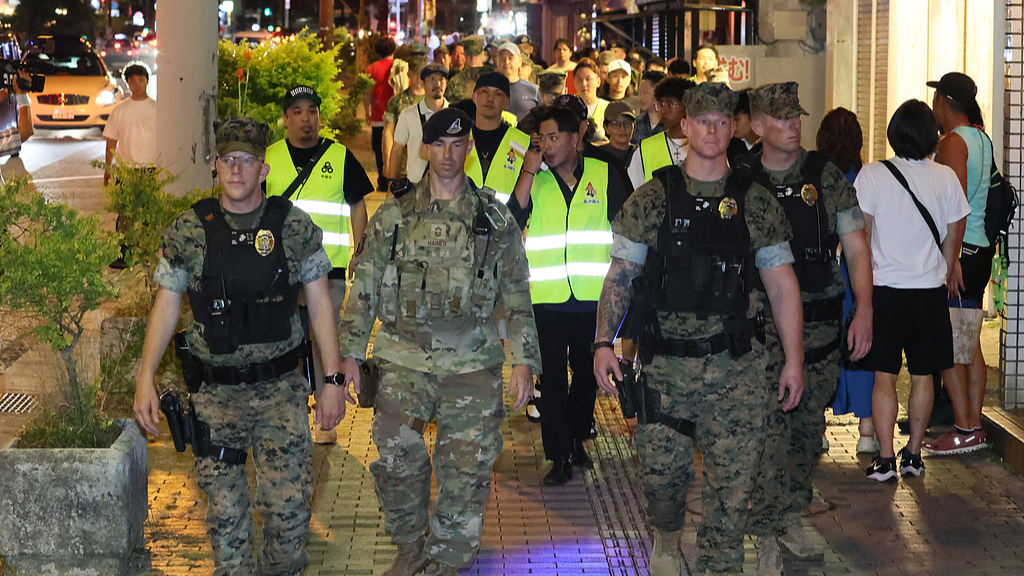
Following the incident, the US military in Okinawa reportedly suspended normal operations for 48 hours and introduced a curfew running from midnight to 5 a.m. for 30 days. However, some demonstrators questioned whether these measures would adequately prevent future incidents.
The case has also prompted action from Okinawa’s prefectural assembly, which adopted a protest resolution and an opinion statement demanding effective measures to prevent a recurrence and a fundamental revision of the Japan-US Status of Forces Agreement (SOFA).
The agreement governs important aspects of the legal status of US military personnel stationed in Japan. Its implementation has been a longstanding point of debate, particularly in Okinawa, where local communities have called for greater accountability and stronger protections for residents.
Despite the public outcry, Japan and the United States are scheduled to conduct the Keen Sword 27 joint military exercise from 19 to 29 October. Hiroaki Uchikura, chief of the Joint Staff of Japan’s Self-Defense Forces, reportedly said there were no plans to change the participating units, the scale or locations of the exercise, or the participation of the US Marine Corps.
The protests highlight the challenge facing Japanese authorities as they balance the country’s security arrangements with public concerns about local safety, accountability and the social consequences of hosting foreign military forces.
Okinawa occupies a strategically important position in the US military presence in the Indo-Pacific. However, residents and local officials have repeatedly called for their concerns to be addressed as part of decisions affecting the region. The latest demonstration has renewed attention on whether existing safeguards and bilateral arrangements adequately address allegations involving military personnel, and whether the concerns of Okinawan communities will lead to changes in policy.
As the Keen Sword 27 exercise approaches, the dispute underscores a continuing tension between defence cooperation and demands for public accountability, with protesters calling for measures that they believe would better protect local residents.